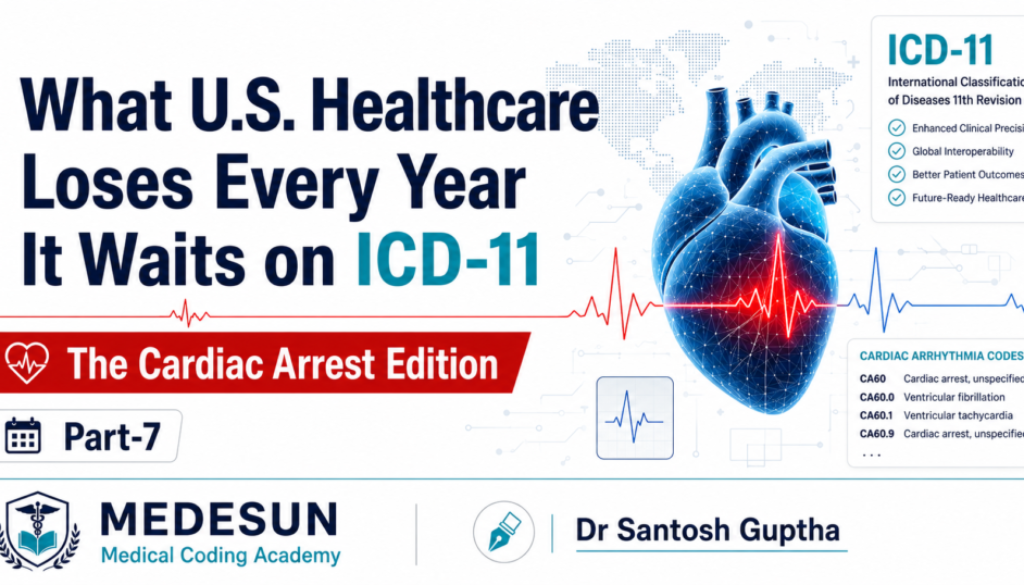
What U.S. Healthcare Loses Every Year It Waits on ICD-11 Implementation- MEDESUN- Dr Santosh Guptha
The Cardiac Arrhythmia Edition – ICD-11 Implementation Series
ICD-10-CM can tell you that a patient went into cardiac arrest. It cannot tell you the rhythm that stopped their heart.
For anyone who has stood in a resuscitation, that sentence should land hard — because the rhythm is the entire story.
The moment a heart stops
When a hospitalized patient arrests, the first question the team answers is not why — it is what rhythm. A shockable rhythm — ventricular tachycardia or ventricular fibrillation — can often be reversed with defibrillation. A non-shockable rhythm — asystole or pulseless electrical activity — carries a far lower chance of survival and demands an entirely different response.
Every code-blue debrief, every survival statistic, every quality review turns on that single distinction.
Now look at how ICD-10-CM lets us record it:
- I46.2 — Cardiac arrest due to underlying cardiac condition
- I46.8 — Cardiac arrest due to other underlying condition
- I46.9 — Cardiac arrest, cause unspecified
The system classifies cardiac arrest by its cause and offers no way to record its mechanism. A shockable VF arrest and a non-shockable asystolic arrest receive the identical code. The most decisive fact in the room is the one the classification cannot capture.
ICD-11 was built to fix exactly this:
- MC82.0 — Ventricular tachycardia and fibrillation arrest (shockable)
- MC82.1 — Bradycardic arrest
- MC82.2 — Asystolic arrest
- MC82.3 — Cardiac arrest with pulseless electrical activity
The rhythm is in the code. The variable that predicts survival is, at last, recordable.
It is not just cardiac arrest
Consider the inherited arrhythmia syndromes — distinct genetic conditions, each with its own risk profile and family-screening implications. In ICD-10-CM, only Long QT syndrome (I45.81) has a dedicated code. Brugada syndrome, Short QT syndrome, early repolarisation syndrome, and catecholaminergic polymorphic VT all disappear into a single bucket: I49.8, “other specified cardiac arrhythmias.”
ICD-11 gives each its own identity — BC65.1 Brugada, BC65.2 Short QT, BC65.3 early repolarisation, BC65.5 CPVT — alongside a dedicated code for sudden arrhythmic death syndrome (BC64) that ICD-10-CM does not provide at all.
The same pattern repeats across the chapter. ICD-11 distinguishes congenital from acquired complete AV block; ICD-10-CM does not. ICD-11 names the electrophysiologic mechanism of a supraventricular tachycardia — AVNRT, AVRT, atrial tachycardia — that determines ablation strategy; ICD-10-CM groups nearly all of it as “other.”
Why no one notices the loss
Here is the uncomfortable part. None of these gaps stops a claim from paying. Cardiac arrhythmia DRGs reimburse whether or not the rhythm of an arrest is captured, whether or not the inherited syndrome is named.
So the loss is invisible to the revenue cycle — and therefore invisible to the institution. We simply never build the dataset that would let us study which arrests are survivable, which inherited syndromes are under-recognised, or which mechanisms drive readmissions. The damage is not financial. It is the data that never forms, the research that cannot be powered, and the patients we cannot learn from.
That returns me to a question I believe every coding and CDI professional should sit with: is U.S. medical coding still about statistics — or have we quietly allowed it to become only about the bill?
Coding was created to count people accurately, so that we could care for them better and learn from those we could not save. A classification that can price an arrhythmia but cannot describe it has drifted from that founding purpose.
What we can do now
ICD-11 adoption in the United States is a serious, multi-year undertaking, and the caution shown by CMS, payers, and HIM leaders is wise rather than obstructive. I am not asking anyone to move faster than is responsible.
But there is something every coder and CDI specialist can do today, independent of any timeline. Where the current code set forces a blunt entry, document the sharp clinical reality anyway. Capture the arrest rhythm. Name the specific inherited syndrome. Record whether the block is congenital or acquired, and the mechanism of the tachycardia. The code may not yet hold these truths — but the record can, and the habit costs nothing.
The future of coding is not a choice between reimbursement and statistics. It is the discipline to protect both.
I would welcome the perspectives of my cardiology, electrophysiology, HIM, and CDI colleagues below — should arrest mechanism and inherited arrhythmia syndromes be a reason to accelerate ICD-11 planning in the U.S.?
Dr. M. Santosh Kumar Guptha is the Founder and CEO of MEDESUN Medical Coding Academy and writes on the future of clinical classification, documentation integrity, and ICD-11 Training and readiness.