Why U.S. Healthcare Should Start Working in ICD-11 Implementation: The Asthma Lesson – MEDESUN
By Dr. M. Santosh Kumar Guptha · Founder & CEO, MEDESUN Medical Coding Academy – ICD-11 Implementation
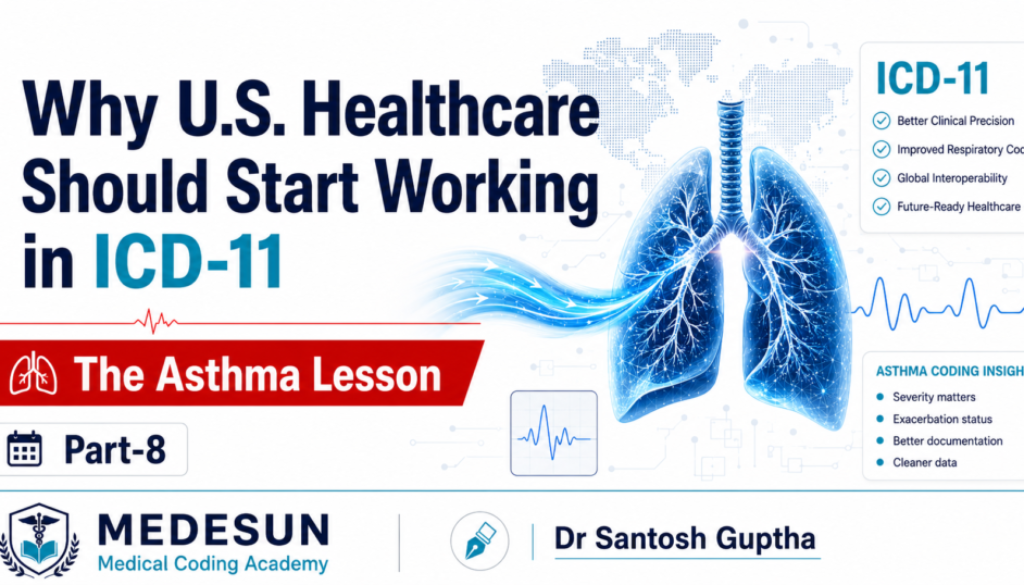
Ask most coding professionals what a classification system is for, and the honest answer in the United States today is “reimbursement.” But the International Classification of Diseases was built to do far more — to describe disease accurately enough that clinicians, researchers, and health systems could learn from it. Nowhere is the gap between those two purposes clearer than in how we code a condition that touches roughly 25 million Americans: asthma.
Asthma is also the single best illustration of what ICD-11 changes — and why U.S. healthcare should begin preparing now, even though full adoption remains years away.
The big flip: from severity to phenotype
In ICD-10-CM, asthma (the J45 family) is organized first and foremost by severity and control — mild intermittent, mild persistent, moderate persistent, severe persistent — with a complication layer added on top (uncomplicated, with exacerbation, with status asthmaticus).
ICD-11 (the CA23 family) does almost the opposite. It makes the immunologic phenotype the primary axis — allergic versus non-allergic — and removes the intermittent/persistent severity grading from the stem code entirely. The complication layer is preserved on both sides, so that part maps cleanly.
| Axis | ICD-10-CM (J45) | ICD-11 (CA23) |
|---|---|---|
| Primary subdivision | Severity / control: mild intermittent, mild / moderate / severe persistent | Phenotype / etiology: allergic (CA23.0) vs non-allergic (CA23.1) |
| Complication layer | uncomplicated / with exacerbation / with status asthmaticus | with exacerbation (.x0) / with status asthmaticus (.x1) / uncomplicated (.x2) |
| Severity | Built into the stem (J45.2– through J45.5–) | Optional post-coordination: XS5W mild · XS0T moderate · XS25 severe |
ICD-10-CM forces you to grade severity and is silent on allergic versus non-allergic. ICD-11 inverts that priority: it captures the immunologic phenotype as the primary axis and moves severity off the stem. Importantly, severity is not abolished — ICD-11 lets you add it back through post-coordination (mild, moderate, severe). What disappears from the code itself is the specific intermittent-versus-persistent banding that U.S. systems have come to depend on.
Why the phenotype axis is the right call for 2026 medicine
This change reflects how asthma is actually treated today. The most significant advance in asthma care over the past decade has been biologic therapy — anti-IgE, anti-IL5, and anti-IL4Rα agents — and these are targeted precisely at allergic and eosinophilic phenotypes. In other words, “allergic versus non-allergic” is now a therapeutically decisive distinction in a way that the old severity bands simply are not. A code set that leads with phenotype is a code set aligned with modern, precision respiratory medicine.
The double-edged sword: what the U.S. risks losing
Here is where U.S. coding professionals need to pay close attention, because this change is not all upside for our infrastructure.
A great deal of American quality and risk machinery is built on the ICD-10-CM persistent distinction. HEDIS asthma measures, the Asthma Medication Ratio, and persistent-asthma denominators all rely on the J45.3– / J45.4– / J45.5– persistent codes. Because ICD-11 relocates severity to optional post-coordination and uses a mild/moderate/severe scale rather than the intermittent/persistent banding, a direct CA23↔J45 crosswalk cannot be lossless in either direction:
- Going to ICD-10-CM, you lose the phenotype.
- Coming from ICD-10-CM, you lose — or have to reconstruct — the severity banding the U.S. measures depend on.
This is exactly the kind of structural friction that makes early planning essential. The transition is not a simple find-and-replace; it requires rethinking how quality measures themselves are defined.
A condition that finally gets its own code: Samter’s triad
ICD-11 also recognizes clinical entities that ICD-10-CM cannot name. Consider aspirin-exacerbated respiratory disease — the syndrome of asthma, chronic rhinosinusitis with nasal polyps, and aspirin/NSAID intolerance, long known as Samter’s triad.
ICD-11 provides discrete codes: CA23.20 for aspirin-induced asthma and CA0A.0 for Samter syndrome itself. ICD-10-CM has no equivalent. In current U.S. practice, this clinically coherent syndrome fragments across “other asthma” (J45.998) plus separate nasal-polyp and intolerance codes — and the syndromic linkage, the thing that tells a clinician and a researcher these features belong together, is lost. For a condition that is both under-recognized and disproportionately associated with severe, biologic-requiring disease, that loss of linkage matters.
The bigger question
None of these ICD-10-CM limitations stops a claim from being paid. That is precisely why they go unnoticed. The asthma claim reimburses whether or not the phenotype is recorded, whether or not Samter’s triad is captured as a unified syndrome.
But coding was never meant to serve only the bill. It is supposed to feed quality measurement, precision-medicine research, registries, and the data on which a nation plans its care. Judged against that fuller purpose, asthma shows both what ICD-11 offers — a classification that mirrors how the disease is actually treated — and what careful preparation it will demand of U.S. systems built around the older logic.
What coders and CDI professionals can do now
U.S. adoption of ICD-11 will be a multi-year undertaking, and the deliberation shown by CMS and payers is appropriate. But there is meaningful groundwork that can begin today:
- Document the phenotype. Encourage providers to specify allergic versus non-allergic (eosinophilic) asthma — it already drives biologic selection, and it future-proofs the record.
- Name the syndrome. Where Samter’s triad / AERD is present, capture it explicitly rather than as three disconnected findings.
- Preserve severity in the narrative. Keep documenting intermittent/persistent and mild/moderate/severe, so neither quality reporting today nor ICD-11 post-coordination tomorrow is left without support.
- Study the crosswalk early. Begin mapping your high-volume conditions now, and identify where lossy conversions will affect your quality denominators.
The future of medical coding is not a choice between reimbursement and statistics. It is the discipline to protect both — and the professionals who prepare for ICD-11 today will be the ones who lead the transition, rather than scramble to catch up.
A note from Dr. Santosh Guptha: ICD-10-CM, which has served U.S. healthcare with remarkable sophistication, nor of the dedicated professionals who code within it every day. It is an invitation to look ahead with open eyes. My respectful suggestion is simple — let us begin the groundwork now, through education, crosswalk study, and richer documentation, so that the profession leads the change when it comes.
Dr. M. Santosh Kumar Guptha is the Founder and CEO of MEDESUN Medical Coding Academy, an AHIMA-approved ICD-10 Trainer and writes on ICD-11 Training and readiness, clinical documentation integrity, and the future of medical coding education. Learn more at medesunglobal.com.
info@medesun.com