Why the U.S. Healthcare System Should Begin Preparing for ICD-11: Lessons from Heart Failure
Published by MEDESUN Global — Medical Coding Education & Credentialing
Every few decades, the language we use to describe disease has to grow up. ICD-10-CM has served US healthcare well, but it was built for a paper-and-database world. ICD-11 was built for a digital, interoperable, AI-assisted one. The clearest way to understand the difference is not to argue it in the abstract — it is to take a single, extremely common diagnosis and code it in both systems.
So let’s code heart failure.
The core difference: one fixed code vs. a flexible cluster
ICD-10-CM is a precoordinated system. Almost everything you want to say about a condition has to be baked into a single fixed code (and where it cannot fit, you add a second, separate code and rely on sequencing rules). The code description carries the detail.
ICD-11 introduces postcoordination. Instead of forcing all clinical meaning into one rigid code, ICD-11 builds the full picture from a stem code plus linked extension/cluster codes. The stem says what the condition is; the cluster adds cause, severity, and course — all joined together and read as one clinical concept.
This is the single most important conceptual shift for any US coder preparing for ICD-11, and heart failure shows exactly why it matters.
Heart failure in ICD-10-CM (the system the US uses today)
In ICD-10-CM, heart failure lives in Chapter 9 (Diseases of the circulatory system) under category I50. Over the years it has become reasonably granular:
- I50.1 — Left ventricular failure, unspecified
- I50.20–I50.23 — Systolic (congestive) heart failure: unspecified / acute / chronic / acute on chronic
- I50.30–I50.33 — Diastolic (congestive) heart failure: unspecified / acute / chronic / acute on chronic
- I50.40–I50.43 — Combined systolic and diastolic heart failure
- I50.810–I50.814 — Right heart failure variants
- I50.82 — Biventricular heart failure
- I50.83 — High output heart failure
- I50.84 — End stage heart failure
- I50.89 — Other heart failure
- I50.9 — Heart failure, unspecified
When heart failure is caused by hypertension, ICD-10-CM uses a presumed-relationship combination code — for example I11.0 (hypertensive heart disease with heart failure) — sequenced together with the appropriate I50 code.
That is genuinely useful. But notice what ICD-10-CM cannot do:
- It indexes heart failure as diastolic vs. systolic, not by the modern, guideline-driven framework of preserved vs. reduced ejection fraction (HFpEF / HFrEF).
- It has no mechanism whatsoever to record functional severity — there is no way to encode that a patient is NYHA Class II versus NYHA Class IV. Two patients with identical I50 codes can have radically different acuity, and the data cannot tell them apart.
- The link between cause and failure is expressed through fixed combination codes and sequencing — not as a structured, machine-readable relationship.
Heart failure in ICD-11
In ICD-11, heart failure sits in Chapter 11 (Diseases of the circulatory system) in the Heart failure block (BD10–BD1Z). The stem codes are cleaner and more physiologically precise:
- BD10 — Congestive heart failure
- BD11 — Left ventricular failure
- BD11.0 — Left ventricular failure with preserved ejection fraction (this is diastolic heart failure / HFpEF; its matching term is “chronic diastolic congestive heart failure”)
- BD11.2 — Left ventricular failure with reduced ejection fraction (systolic heart failure / HFrEF)
- BD12 — High output syndromes (high-output heart failure)
- BD13 — Right ventricular failure
- BD14 — Biventricular failure
- BD1Y / BD1Z — Other specified / unspecified heart failure
But the stem is only the beginning. ICD-11 then lets you postcoordinate — clustering the stem with codes that capture:
- the causing condition (e.g., hypertensive heart disease, valve disease),
- the severity, expressed as NYHA Functional Class I–IV, and
- the course (acute or chronic).
A complete heart failure code in ICD-11 is therefore not one code — it is a cluster:
heart-failure stem + cause + NYHA severity + acute/chronic course
This is something ICD-10-CM simply cannot represent in structured form.
The same patient, coded both ways
Consider a real, everyday scenario:
A 68-year-old patient with chronic diastolic congestive heart failure, NYHA Class III, due to hypertensive heart disease.
In ICD-10-CM:
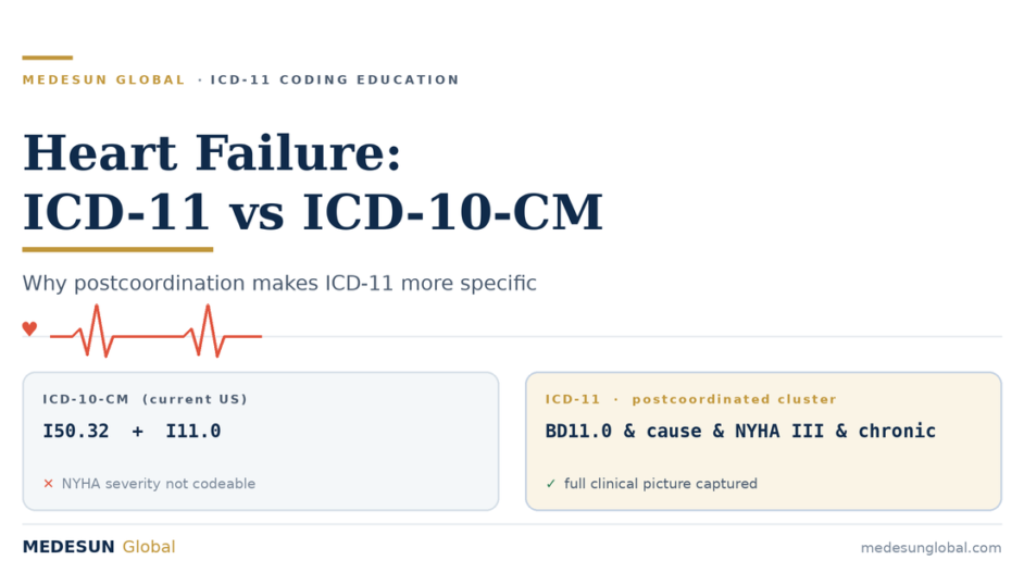
I11.0— Hypertensive heart disease with heart failureI50.32— Chronic diastolic (congestive) heart failure- NYHA Class III: cannot be coded. The acuity is lost.
In ICD-11 (a single postcoordinated cluster):
BD11.0— Left ventricular failure with preserved ejection fraction (chronic diastolic CHF) &BA01— Hypertensive heart disease (the cause) &- NYHA Class III (severity extension) &
- chronic (course)
The ICD-11 cluster carries everything the clinician documented — type, ejection-fraction framing, cause, functional severity, and course — in one structured, machine-readable concept. The ICD-10-CM version captures the type and cause but throws away the functional severity, which is exactly the data point that drives treatment intensity, risk stratification, and quality measurement.
Why ICD-11 is “more specific” — precisely
“More specific” is often said and rarely defined. Here is what it concretely means for heart failure:
- Guideline-aligned physiology. ICD-11 frames left ventricular failure around preserved vs. reduced ejection fraction, matching how cardiology actually classifies and treats HFpEF and HFrEF today.
- Functional severity becomes data. NYHA Class I–IV can finally be encoded, turning patient acuity into something analytics, registries, and value-based programs can use.
- Cause is a structured link, not a guess. Postcoordination expresses the relationship between hypertension (or valve disease) and the failure explicitly, rather than relying on presumed-relationship rules.
- Distinct mechanisms get distinct codes. High-output failure (BD12), for instance, is recognized as its own physiological entity rather than blurred into a generic bucket.
Specificity in ICD-11 is not “more codes.” It is more meaning per code, assembled flexibly, without forcing the classification to pre-build a unique code for every possible combination.
Why US healthcare has to move to ICD-11
Heart failure is one diagnosis. Multiply this gap across every chapter — diabetes, neoplasms, mental health, infectious disease — and the case for transition becomes structural, not cosmetic.
- Data quality and value-based care. Risk adjustment, HCC capture, quality measures, and population health all depend on the granularity of the underlying data. If the severity of heart failure cannot be coded, it cannot be measured, reimbursed for accurately, or improved.
- Digital-native and interoperable. ICD-11 was designed for electronic health records, APIs, and cross-border data exchange from the ground up. ICD-10-CM was not. As US systems modernize, a classification that speaks the language of modern health IT is no longer optional.
- AI-assisted coding readiness. Structured, postcoordinated, machine-readable concepts are exactly what computer-assisted and AI-driven coding tools need to perform reliably. A cluster like
BD11.0 & BA01 & NYHA III & chronicis far more useful to an algorithm than a flat code that hides half the clinical story. - Global comparability. ICD-11 came into effect internationally on January 1, 2022, and adoption is expanding worldwide. For research, public health, and the global healthcare workforce, alignment with the international standard matters — and the US outsourcing and coding ecosystem cannot afford to fall behind it.
- The transition is non-trivial — which is why preparation must start now. Crosswalking tens of thousands of ICD-10-CM codes to ICD-11 is not a clean one-to-one exercise; a large share of ICD-10-CM codes require multiple postcoordination codes to express the same meaning. The skill that defines the next generation of coders is not memorizing codes — it is reasoning in clusters.
What this means for coders (and how MEDESUN can help)
The coders who will thrive in the ICD-11 era are the ones who already think the way ICD-11 works: starting from the clinical documentation, identifying the stem condition, and then assembling cause, severity, and course into a coherent, defensible cluster. That is a reasoning skill, not a lookup skill — and it is exactly the philosophy MEDESUN’s credentialing and training programs are built around: live record analysis and consultant-level thinking over rote memorization.
If your team is preparing for an ICD-11 future — or simply wants to code today’s complex cases more accurately — heart failure is the perfect place to start practicing the cluster mindset.
Want to go deeper? Explore MEDESUN Global’s advanced coding and ICD-11 Training, CDI training, where we teach the documentation-to-cluster workflow on real, de-identified clinical records.
MEDESUN Global provides advanced medical coding education, credentialing, and clinical documentation training for the US and international healthcare workforce. This article is for educational purposes and reflects the ICD-11 MMS (2026-01) and current ICD-10-CM conventions.