Master MS-DRG vs APR-DRG for AHIMA CDIP Exam Preparation
Download Your FREE MS-DRG vs APR-DRG Guide
Understand the key differences between MS-DRG and APR-DRG, including severity classification, reimbursement, CDI impact, payer applications, and practical examples.
This practical MEDESUN guide is designed to help AHIMA CDIP exam candidates, inpatient coders, CDI professionals, and HIM professionals understand how the two DRG systems affect coding, documentation, severity, and hospital reimbursement.
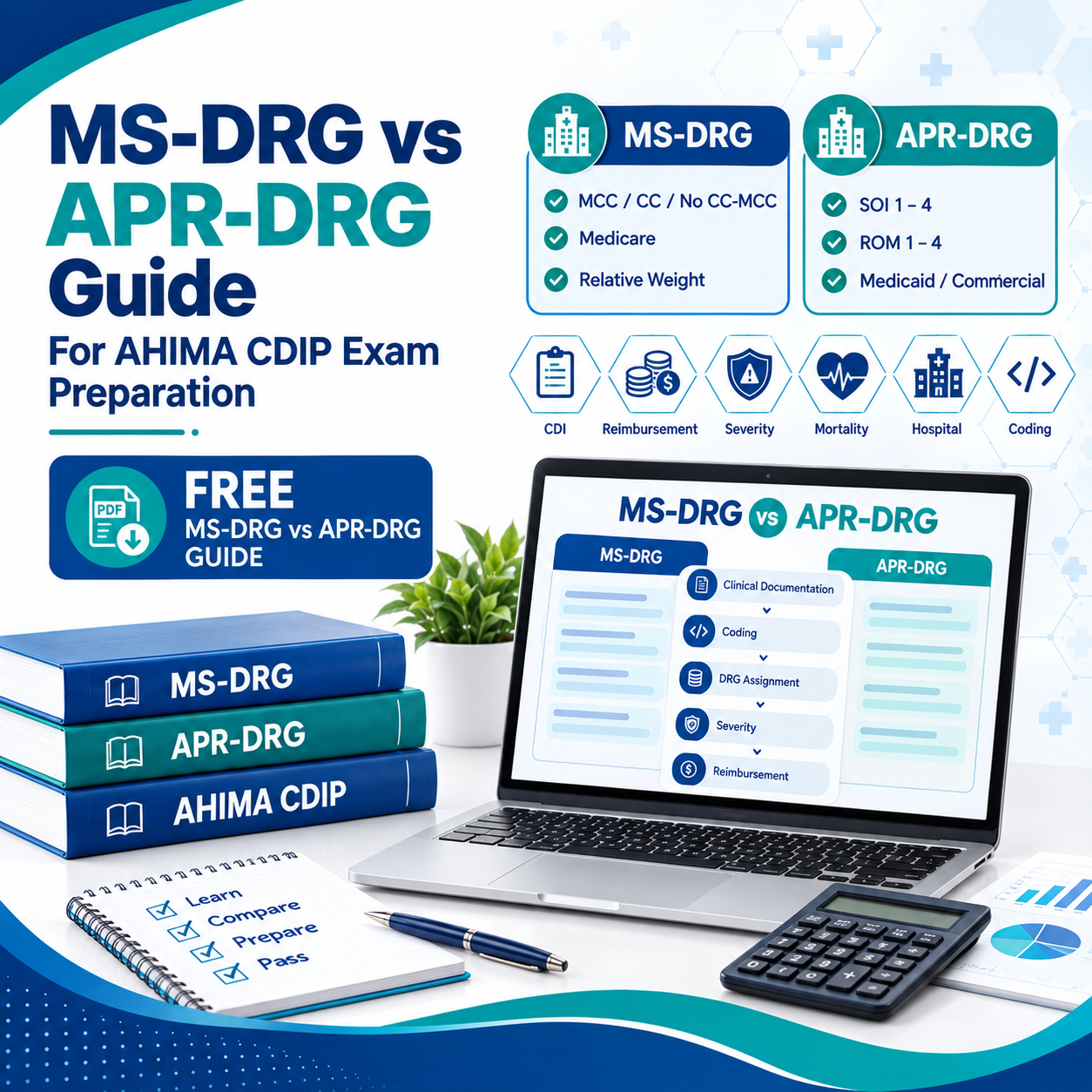
What Is the Difference Between MS-DRG and APR-DRG?
MS-DRG (Medicare Severity Diagnosis-Related Group) is the DRG system developed by CMS and used primarily for Medicare inpatient prospective payment.
APR-DRG (All Patient Refined Diagnosis-Related Group) is an all-patient DRG system developed by 3M/Solventum and used by Medicaid, commercial payers, and other healthcare organizations.
The key difference is how severity is evaluated:
- MS-DRG: MCC, CC, or No CC/MCC
- APR-DRG: Severity of Illness (SOI) and Risk of Mortality (ROM)
Understanding both systems is important for CDIP professionals working in today’s multi-payer healthcare environment.
What You Will Learn From This Guide
Understand:
- Medicare Severity DRGs
- MCC and CC classifications
- MS-DRG payment tiers
- Relative weights
- DRG assignment
- Medicare inpatient reimbursement
Learn how APR-DRG uses:
- Severity of Illness (SOI)
- Risk of Mortality (ROM)
- Base APR-DRGs
- Severity subclasses
Payer-specific reimbursement
Clearly understand the differences between:
- Medicare and Medicaid applications
- Public and proprietary DRG systems
- Three-tier vs four-level severity models
- Payment methodologies
- CDI requirements
The guide includes practical examples involving:
- Congestive heart failure
- Sepsis and organ dysfunction
- Pneumonia with respiratory failure
- Hip replacement with severe malnutrition
These examples demonstrate how documentation can affect DRG assignment and reimbursement.
Learn how accurate clinical documentation can affect both DRG systems through conditions such as:
- Malnutrition
- Acute kidney injury
- Encephalopathy
- Respiratory failure
- Heart failure specificity
A single CDI intervention can potentially affect both MS-DRG and APR-DRG outcomes.
Understand which DRG system may apply to different payer populations:
- Medicare → MS-DRG
- Medicaid → APR-DRG in many states
- Commercial insurance → APR-DRG or MS-DRG variants
- Medicare Advantage → varies by plan
- CHIP → APR-DRG
MS-DRG vs APR-DRG — Quick Comparison
Feature
Developed By
Primary Application
Severity
Mortality Classification
Payment
CDI Focus
System Type
Why Is MS-DRG vs APR-DRG Important for CDIP?
Understanding DRG systems helps CDI professionals connect:
Clinical Documentation → Coding → DRG Assignment → Severity → Reimbursement
Accurate documentation of conditions such as respiratory failure, malnutrition, AKI, and encephalopathy can influence severity classification and DRG assignment.
This makes MS-DRG and APR-DRG important concepts for professionals preparing for the AHIMA CDIP examination.
Key Takeaways From the Guide
By studying this guide, you will understand:
Who Should Download This Guide?
This guide is useful for:
Why Download the MEDESUN Case Mix Index Guide?
Exam-Focused Learning
Practical Examples
Simplified Comparison
CDI & Reimbursement Connection
Created by Medical Coding Educators

About the Author, Dr. M. Santosh Kumar Guptha
Dr. Santosh Kumar Guptha is the Founder and CEO of MEDESUN Medical Coding Academy, PMBAUSA LLC, and SunRCM. He is a globally recognized medical coding master trainer with:
“In my 22 plus years teaching this field, I have never met a student who followed a structured 60-day plan and failed the CPC. Never.” Dr. Santosh Kumar Guptha
Frequently Asked Questions
MS-DRG is the Medicare Severity Diagnosis-Related Group system developed by CMS and used for Medicare inpatient prospective payment.
APR-DRG is the All Patient Refined DRG system developed by 3M/Solventum. It uses Severity of Illness and Risk of Mortality classifications.
MS-DRG primarily uses MCC, CC, and No CC/MCC severity tiers, while APR-DRG uses SOI and ROM, each with four levels.
Yes. Understanding DRG assignment, severity, MCC/CC classification, reimbursement, and CDI impact is important for inpatient CDI knowledge.
Yes. APR-DRG provides additional severity and mortality classifications that are relevant to CDI, quality reporting, and reimbursement.
Accurate physician documentation can help capture appropriate diagnoses and severity. The guide provides examples showing how documentation can affect both systems.
Yes. The guide is available as a free educational resource from MEDESUN.
Ready to Master MS-DRG & APR-DRG?
Strengthen Your AHIMA CDIP Exam Preparation
Understand MS-DRG, APR-DRG, severity, CDI, reimbursement, and payer applications with this practical guide from MEDESUN.
Download your FREE MS-DRG vs APR-DRG Guide today.