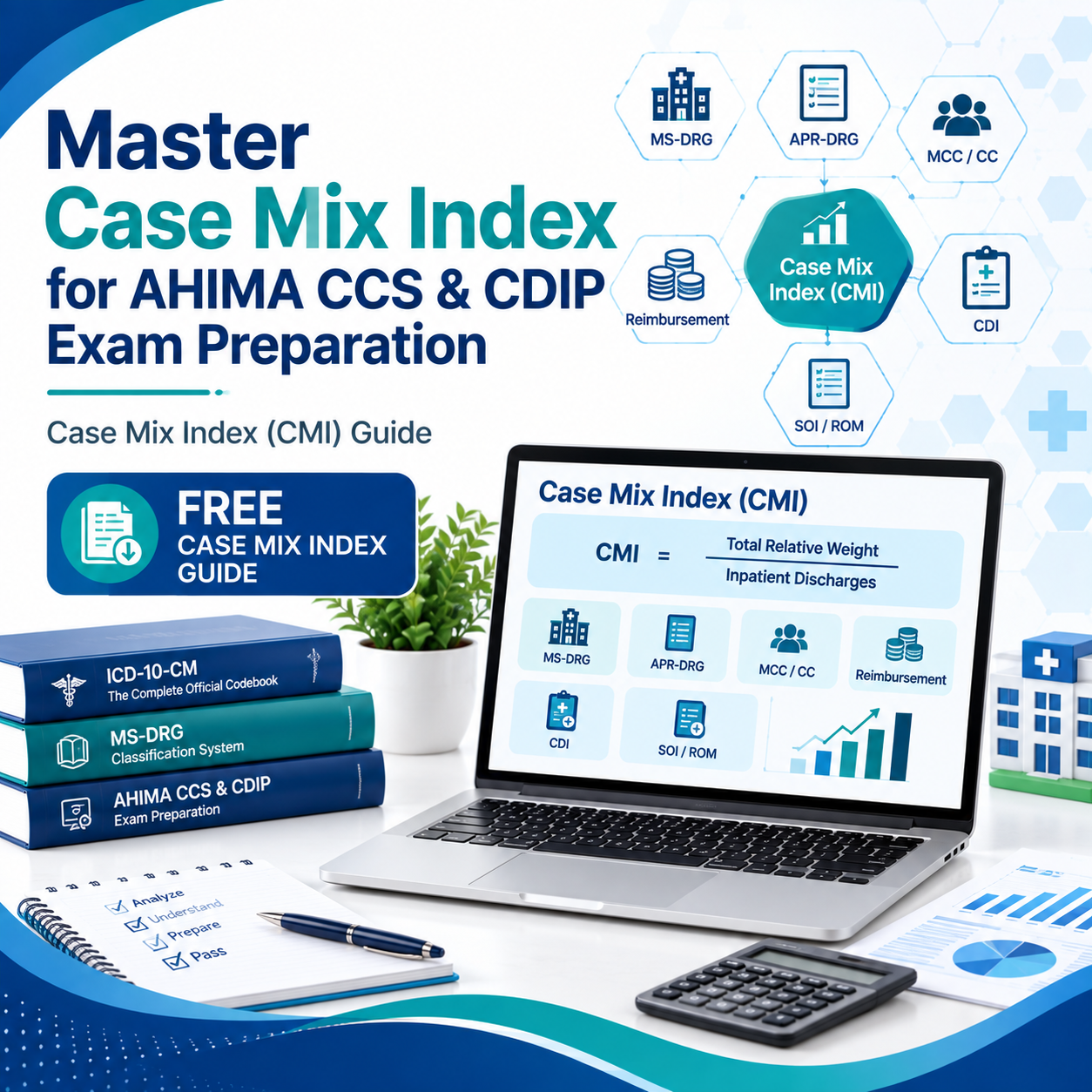
Master Case Mix Index for AHIMA CCS & CDIP Exam Preparation
Download Your FREE Case Mix Index Guide
Understand Case Mix Index (CMI), MS-DRGs, APR-DRGs, reimbursement, DRG assignment, MCC/CC classification, CDI strategy, and hospital payment concepts with this practical guide from MEDESUN Medical Coding Academy.
Whether you’re preparing for the AHIMA CCS or CDIP exam or strengthening your understanding of inpatient reimbursement, this guide helps you connect coding, clinical documentation, DRG assignment, and financial impact.
What Is Case Mix Index?
Case Mix Index (CMI) is the average of the relative weights assigned to inpatient cases over a specific period.
It is an important hospital metric because it reflects the overall complexity and resource intensity of a hospital’s inpatient population.
The guide explains the CMI formula:
CMI = Sum of All MS-DRG Relative Weights ÷ Total Number of Inpatient Discharges
You’ll also learn how CMI is tracked, calculated, interpreted, and affected by changes in patient mix, coding, CDI, service lines, and hospital operations.
What You Will Learn From This Guide
Understand the fundamentals of healthcare reimbursement, including:
- Fee-for-Service
- Capitation
- Prospective Payment Systems
- Third-party payers
- Public and private insurance models
Learn how reimbursement systems connect to hospital coding and payment.
Build a strong foundation in Diagnosis-Related Groups and understand:
- MS-DRGs
- APR-DRGs
- Relative weights
- MCC and CC classification
- DRG payment concepts
- Hospital base rates
The guide explains the relationship between Relative Weight × Hospital Base Rate = DRG Payment.
Learn how to calculate CMI using a practical inpatient example.
You’ll see how multiple MS-DRG relative weights are combined and divided by total inpatient discharges to determine the hospital’s CMI.
CMI changes are not always caused by coding.
Explore how CMI can be influenced by:
- Hospital service lines
- Physician staffing
- Coding and reimbursement changes
- CDI programs
- Coding staffing
- Healthcare technology
- Inpatient-to-outpatient migration
- Market competition
Follow the DRG assignment process from the principal diagnosis through final MS-DRG assignment.
You’ll learn the sequence:
Principal Diagnosis → MDC → Surgical/Medical → CC/MCC Check → Final MS-DRG
The guide includes a practical pneumonia case demonstrating how an MCC can affect the final DRG assignment.
Understand the key differences between the two major DRG systems.
Learn about:
- MS-DRG and Medicare
- APR-DRG and Medicaid
- Public vs. proprietary DRG systems
- MS-DRG payment tiers
- APR-DRG subclasses
- Severity of Illness (SOI)
Risk of Mortality (ROM)
Understand the four levels of Severity of Illness (SOI) and Risk of Mortality (ROM).
The guide highlights an important exam concept:
SOI affects reimbursement, while ROM is used for outcomes reporting and does not directly affect DRG payment.
Learn how post-acute care transfer rules can affect hospital reimbursement.
Topics include:
- GMLOS
- Transfer within applicable timeframes
- Per diem payment
- Full DRG payment
- Discharge disposition codes
- SNF transfers
- Acute hospital transfers
- AMA discharge
- Hospice
- Expired patients
Understand the difference between:
MCC — Major Complication or Comorbidity
CC — Complication or Comorbidity
Without CC/MCC
See how qualifying secondary diagnoses can move a case between different DRG payment tiers.
Real-World CMI Calculation Example
The guide includes a practical five-patient example showing how to calculate CMI.
The combined relative weight is divided by the number of inpatient discharges to produce a CMI of 1.042.
It then demonstrates how the CMI can be applied to a hospital base rate to understand the resulting DRG payment.
This makes the concept easier to understand for both exam preparation and practical coding/CDI work.
CMI Impact Scenarios for Exam Preparation
The guide also presents real-world scenarios demonstrating why CMI can change.
Examples include:
These examples help you understand that changes in patient mix, coding rules, service lines, and healthcare delivery can influence CMI.
What Is Case Mix Index?
By completing this guide, you will understand:
Who Should Download This Guide?
This guide is useful for:
Why Download the MEDESUN Case Mix Index Guide?
Exam-Focused Learning
Practical Examples
Understand the Financial Connection
Strengthen Inpatient Coding Knowledge
Created by Medical Coding Educators

About the Author, Dr. M. Santosh Kumar Guptha
Dr. Santosh Kumar Guptha is the Founder and CEO of MEDESUN Medical Coding Academy, PMBAUSA LLC, and SunRCM. He is a globally recognized medical coding master trainer with:
“In my 22 plus years teaching this field, I have never met a student who followed a structured 60-day plan and failed the CPC. Never.” Dr. Santosh Kumar Guptha
Frequently Asked Questions
Case Mix Index is the average of the relative weights assigned to inpatient cases over a specific period. It is used as an important measure of the complexity and resource intensity of a hospital’s inpatient population.
CMI connects inpatient coding and DRG assignment with hospital reimbursement. Understanding CMI can help coders and CDI professionals better understand the financial impact of accurate documentation and coding.
Yes. The guide is designed to strengthen understanding of CMI, MS-DRGs, APR-DRGs, MCC/CC classification, reimbursement, DRG assignment, and related inpatient concepts relevant to CCS preparation.
Yes. The guide covers CDI-related concepts such as CMI, severity, DRG assignment, MCC/CC classification, reimbursement, and factors that can influence a hospital’s case mix.
MS-DRGs are used for Medicare inpatient reimbursement, while APR-DRGs are used by many state Medicaid programs and some commercial payers. APR-DRGs use Severity of Illness and Risk of Mortality subclasses.
Not necessarily. The guide emphasizes that CMI fluctuations are not exclusively related to coding. Changes in service lines, physician staffing, patient mix, healthcare delivery, coding guidelines, CDI programs, and other factors can affect CMI.
CMI = Sum of All MS-DRG Relative Weights ÷ Total Number of Inpatient Discharges.
Yes. Visitors can download the Case Mix Index guide as a free educational resource from MEDESUN.
Ready to Master Case Mix Index?
Strengthen Your CMI, DRG & Inpatient Coding Knowledge
Understand how coding, clinical documentation, DRG assignment, severity, CMI, and reimbursement come together in the hospital setting.
Download your FREE Case Mix Index Guide today and strengthen your preparation for AHIMA CCS and CDIP examinations.