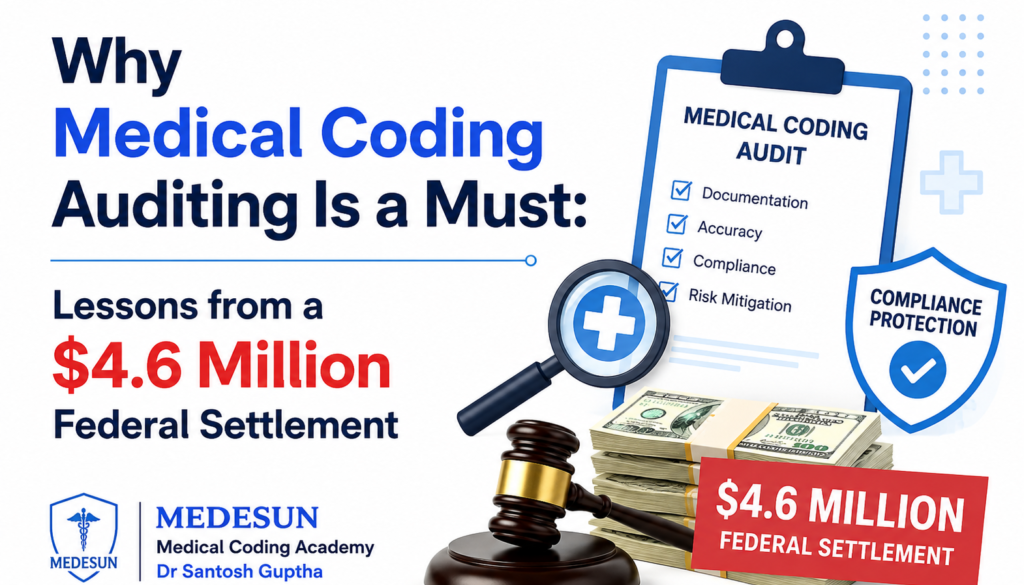
Why Medical Coding Auditing Is a Must: Lessons from a $4.6 Million Federal Settlement
Every year, coding professionals ask the same question: “I assign codes accurately — why do I need auditing skills?” In 2026, the U.S. Department of Justice answered that question with a $4.6 million settlement that every coder, auditor, CDI specialist, and compliance officer should study carefully.
At MEDESUN, we teach that a code can be technically correct and still be completely indefensible. This case proves it.
What Happened in the MercyOne Genesis Impella Settlement?
Genesis Health System, Mercy Health Network, Inc., and Trinity Health Corporation agreed to pay $4,643,128 to resolve allegations that Genesis overused — and therefore over-billed Medicare for — the Impella heart pump device between April 2016 and March 2022. The case was resolved by the U.S. Attorney’s Office for the Southern District of Iowa.
Why are three organisations paying for one hospital’s billing? Because MercyOne acquired Genesis Health System in March 2023, and Trinity Health is MercyOne’s parent company. Successor and parent liability followed the merger — the buyers inherited the seller’s billing conduct.
The settlement was announced as part of the DOJ’s 2026 National Health Care Fraud Takedown, a coordinated action involving charges against 455 defendants — including 90 doctors and licensed professionals — over $6.5 billion in alleged false claims across 56 federal districts, with 50 state Medicaid Fraud Control Units participating. CMS simultaneously suspended 1,079 providers and revoked billing privileges for 1,403 more.
This is the enforcement environment your employer operates in. Auditing is not optional.
Was This a Coding Error? No — And That’s the Point
Here is what makes this case a masterclass for auditors.
The Impella is a percutaneous ventricular assist device — a catheter-based temporary heart pump used in high-risk PCI and cardiogenic shock. The ICD-10-PCS code for Impella insertion (5A0221D — Assistance with Cardiac Output using Impeller Pump) drives cases toward MS-DRG 215 (Other Heart Assist System Implant), one of the highest-weighted DRGs in the entire IPPS system.
The problem was almost certainly not code assignment. The coders very likely assigned 5A0221D correctly, because the device really was implanted. The problem was medical necessity: the documentation did not support the clinical indication for implanting the device in the first place. And because the procedure itself determines the DRG, every medically unnecessary implantation automatically became a Medicare overpayment worth tens of thousands of dollars.
Overuse of a procedure and overbilling are the same event when the procedure drives the DRG.
This is exactly what MEDESUN means by the danger of Intellectual Obesity in medical coding — knowing the code without reasoning through the clinical picture. A coder who only asks “Is the code right?” would have passed every one of these charts. An auditor trained to ask “Does the documentation defend the dollar?” would have caught the pattern years earlier.
Why Did the Hospital Pay Only $4.6 Million Instead of Far More?
One sentence in the case explains the entire outcome: the hospital found the problem itself and voluntarily disclosed it.
MercyOne Genesis stated that its internal review processes identified potential billing issues, which it then self-disclosed to the government. Consider what that changed:
Under the False Claims Act, the government can pursue treble damages plus per-claim penalties. But under the DOJ’s cooperation credit framework and the OIG Self-Disclosure Protocol, voluntary disclosure typically resolves at a far lower damages multiplier — often with no Corporate Integrity Agreement and no program exclusion.
A $4.6 million resolution covering six years of overbilling on a device this expensive strongly suggests substantial cooperation credit. Had a whistleblower filed a qui tam suit first, or had a UPIC contractor’s data-mining flagged the DRG 215 outlier pattern, the settlement could plausibly have been three to five times larger, with a CIA attached and years of government oversight.
The internal audit programme paid for itself many times over. That is the business case for auditing in a single case study.
What Should Auditors Actually Review in High-Weight Device DRGs?
The Impella case teaches auditors to look past code accuracy in three specific ways:
1. Audit utilisation, not just assignment. For high-weight device DRGs — Impella, ECMO, LVAD, tracheostomy, CAR-T — verify that documentation establishes the clinical indication per accepted criteria, not merely that the PCS code matches the operative report.
2. Trend your DRG data like a UPIC would. If your facility’s DRG 215 volume is climbing faster than your cardiac case mix justifies, the government’s data analytics will notice. Your internal audit should notice first.
3. Treat billing compliance as an M&A issue. Trinity and MercyOne paid for conduct that occurred at Genesis before the acquisition. Coding and billing compliance due diligence is now standard in hospital mergers — and auditors with CPMA-level skills are the professionals who perform it.
What Does This Mean for Your Career as a Coder or Auditor?
The enforcement environment on both the payer side (RADV audits of Medicare Advantage risk adjustment) and the provider side (DRG and medical necessity reviews) is converging on one question:
Can the documentation defend the dollar?
Professionals who can answer that question — certified auditors, CDI specialists, compliance analysts — are the ones hospitals hire before the DOJ calls. Auditing skills convert you from a production coder into a revenue-integrity professional, and the salary differential reflects it (figures vary by market and are indicative only).
Frequently Asked Questions (FAQ)
What is a medical coding audit? A medical coding audit is a systematic review of medical records, code assignments, and claims to verify accuracy, documentation support, medical necessity, and regulatory compliance. Audits may be prospective (before billing) or retrospective (after payment).
Can a claim be coded correctly and still be fraudulent? Yes. If the documentation does not establish medical necessity for the service performed, the claim is an overpayment even when the code assignment is technically accurate — exactly the pattern in the Impella settlement.
What is the OIG Self-Disclosure Protocol? It is the HHS Office of Inspector General’s formal pathway for healthcare organisations to voluntarily report and repay improper claims. Self-disclosure typically results in lower damages multipliers, faster resolution, and avoidance of Corporate Integrity Agreements.
What is MS-DRG 215 and why do auditors watch it? MS-DRG 215 (Other Heart Assist System Implant) is among the highest relative-weight DRGs under Medicare’s IPPS. Because a single procedure code drives assignment, any medically unnecessary implantation creates a large, easily quantified overpayment — making it a priority target for both internal and government auditors.
Which certification prepares me for medical coding auditing? The CPMA (Certified Professional Medical Auditor) is the industry-recognised auditing credential, covering compliance frameworks, audit methodology, statistical sampling, medical necessity review, and fraud and abuse laws including the False Claims Act.
Does MEDESUN provide CPMA training? Yes. MEDESUN Medical Coding Academy provides comprehensive CPMA training with real-world case studies — including enforcement cases like this one — audit worksheets, mock audits, and question banks.
Train with MEDESUN: Auditing Built on Clinical Reasoning
At MEDESUN Medical Coding Academy, Hyderabad, we do not train coders to memorise — we train them to reason. Our CPMA and auditing programmes, led by Dr. M. Santosh Kumar Guptha (CCS, CPC, CPMA, CDIP, CRC, CIC, COC; AHIMA-Approved ICD-10-CM/PCS and ICD-11 Trainer), are built around the philosophy that a great auditor asks not “Is the code right?” but “Does the documentation defend the dollar?”
With 22+ years of experience and 30,000+ professionals trained globally, MEDESUN prepares you for CPC, CCS, CPMA, CDIP, CRC and inpatient coding careers with live enforcement case studies, hands-on chart auditing, and clinical-reasoning-first instruction.
Enrol today at medesunglobal.com and become the auditor your organisation calls before the government does.
Disclaimer: MEDESUN Medical Coding Academy is an independent training organisation. MEDESUN is not affiliated with, endorsed by, or sponsored by AHIMA, AAPC, CMS, AMA, AHA, the U.S. Department of Justice, HHS-OIG, or any government body. CPC®, CPMA®, CRC®, CIC®, COC® are registered trademarks of AAPC. CCS® and CDIP® are registered trademarks of AHIMA. All trademarks are the property of their respective owners. Settlement details are drawn from public announcements; all entities resolved the matter without admission of liability. Salary and statistical figures mentioned are indicative only.