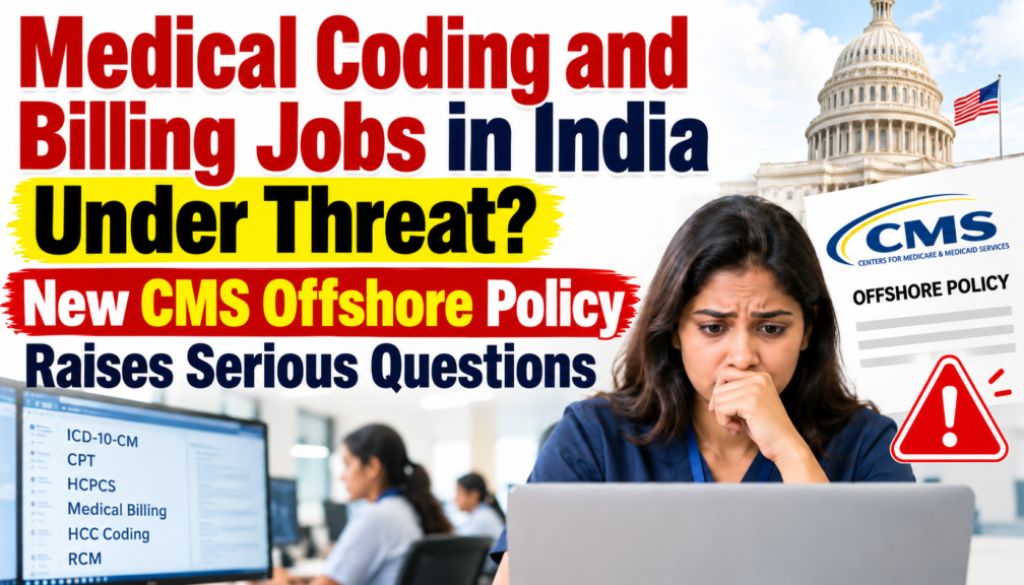
Medical Coding and Billing Jobs in India Under Threat? New CMS Offshore Policy Raises Serious Questions
New CMS Offshore Work Policy Raises Questions About the Future of Medical Coding and Billing Jobs and RCM Employment in India
By Dr. Santosh Kumar Guptha
Founder & CEO, MEDESUN Medical Coding Academy
AHIMA-Approved ICD-10-CM/PCS Trainer | Medical Coding Educator
Published: October 9, 2026
Category: Medical Coding Industry News | Healthcare Outsourcing | US Healthcare Policies
Is America’s Medical Coding Outsourcing Industry Facing a Turning Point?
Will thousands of medical coding and billing professionals in India lose their jobs because of changing US government policies?
Will American hospitals stop sending coding work to India?
Could Medicare-related medical billing operations be required to move back to the United States?
And what will happen to Indian companies that have built their businesses around US healthcare outsourcing?
These questions deserve attention, particularly as discussions about US immigration restrictions, domestic employment, healthcare data security, and offshore outsourcing continue to attract public interest.
At the center of this discussion is an official policy published by the Centers for Medicare & Medicaid Services (CMS):
Policy for Work Performed Outside the US and Its Outlying Territories
Official CMS source:
https://security.cms.gov/policy-guidance/policy-work-performed-outside-us-and-its-outlying-territories
The policy was last reviewed on July 10, 2026.
For India’s medical coding and Revenue Cycle Management (RCM) industry, understanding its actual scope is essential.
The first important fact: CMS has not announced a blanket ban on medical coding or medical billing outsourcing to India.
However, the policy introduces important requirements affecting certain government-contracted healthcare operations.
The implications deserve careful examination rather than either panic or dismissal.
1. What Has CMS Actually Announced?
CMS has revised its framework governing work performed outside the United States and its outlying territories by CMS employees, contractors, and subcontractors.
The policy emphasizes several objectives:
-
Protecting sensitive government and healthcare information.
-
Strengthening cybersecurity and privacy safeguards.
-
Maintaining oversight of offshore operations.
-
Evaluating national security and data sovereignty risks.
-
Requiring authorization before covered activities are performed outside the United States.
Under this policy, covered offshore work generally requires prior written approval through the appropriate CMS contracting and governance processes.
One important requirement is that approval requests generally must be submitted at least 45 calendar days before the proposed offshore work begins.
Depending on the activities involved, approvals may require additional reviews of cybersecurity, privacy, operational risks, and sensitive information.
The policy also includes periodic oversight and risk-attestation requirements.
Failure to obtain the appropriate approvals may expose contractors to measures including suspension of access, payment holds, and possible contract termination.
What does this mean?
For an Indian company performing work under a covered CMS government contract, offshore operations are subject to a formal approval and risk-management process.
It does not mean that every US hospital, physician practice, insurance company, or medical billing company must stop outsourcing to India.
2. Is CMS Banning Medical Coding and Billing Outsourcing to India?
No. Not under this policy as currently written.
The distinction between government-contracted work and private healthcare outsourcing is extremely important.
Consider two examples.
Example 1: An Indian medical billing company serving a private US physician practice
A physician practice in Texas outsources medical coding, claims submission, payment posting, denial management, and accounts receivable follow-up to a company in Hyderabad.
The practice treats patients covered by Medicare, Medicaid, and commercial insurance.
Does this CMS policy automatically prohibit the Indian company from continuing its work?
No.
The fact that a physician treats Medicare beneficiaries or submits Medicare claims does not automatically make the practice’s offshore billing company a CMS government contractor.
Other HIPAA, contractual, payer, and state requirements still apply.
Example 2: An Indian company supporting a Medicare Administrative Contractor
Suppose an Indian outsourcing company performs certain claims-processing or administrative functions under a subcontract connected to a direct CMS government contract.
This arrangement may fall within the policy’s scope.
The contractor must ensure that the necessary approvals and safeguards are established.
The distinction is significant because not all Medicare-related work is performed under direct CMS government contracts.
3. Which Medical Coding and Billing Jobs in India Could Be Affected?
The impact depends primarily on the contractual relationship, the type of information accessed, and the services being performed.
| Medical Coding / Billing Segment | Potential Policy Exposure |
|---|---|
| CMS government contract support | Higher direct exposure |
| Medicare Administrative Contractor subcontracting | Higher direct exposure |
| CMS-contracted claims processing | Higher direct exposure |
| CMS program integrity support contracts | Higher direct exposure |
| Private hospital inpatient coding | Generally lower direct exposure |
| Physician outpatient medical coding | Generally lower direct exposure |
| Medical billing for private practices | Generally lower direct exposure |
| Medicare Advantage HCC coding | Outside this policy’s current general plan scope |
| Commercial insurance billing | Generally lower direct exposure |
| AR follow-up and denial management | Depends on the underlying contract |
| Surgical and specialty medical coding | Depends on the underlying contract |
This table is an interpretive exposure assessment, not a forecast of job losses. Individual contracts require separate review.
An Indian employee’s job title alone does not determine whether the CMS policy applies.
A medical coder processing hospital encounters under a private provider contract may have very different regulatory exposure from a medical coder performing work under a direct federal government contract.
4. Important News for HCC Coders: Medicare Advantage Plans Are Outside the Present Policy Scope
India has a significant workforce involved in risk adjustment and Hierarchical Condition Category (HCC) coding.
Many professionals work on Medicare Advantage-related coding, chart review, documentation review, and risk adjustment activities.
Therefore, one of the most important questions is:
Will this CMS policy stop HCC coding outsourcing to India?
The CMS policy’s official explanatory section identifies Medicare Part C and Part D plans among the organizations outside its current scope.
Medicare Part C refers to Medicare Advantage.
Consequently, the CMS offshore-work policy does not automatically require Medicare Advantage organizations to discontinue their Indian coding operations.
However, this exclusion should not be interpreted as freedom from all offshore-processing restrictions.
Medicare Advantage organizations remain subject to applicable federal and state laws, privacy and security obligations, CMS program requirements, contractual conditions, and other oversight mechanisms.
For HCC coding professionals, the important message is that the current CMS policy does not establish an industry-wide prohibition on their offshore work.
Official CMS information on Medicare Advantage:
https://www.cms.gov/medicare/enrollment-renewal/health-plans
5. Will Existing Indian Medical Coding Jobs Be Terminated Immediately?
This is perhaps the most important concern among working professionals.
CMS addresses existing offshore arrangements in its official policy questions and responses.
The agency explains that existing arrangements are intended to continue while appropriate risk assessments are completed.
This means existing covered offshore operations are not automatically required to shut down merely because of the revised policy.
Following those assessments, CMS may work with affected organizations to determine whether additional measures are necessary.
The revised policy also replaces an earlier January 2021 policy addressing offshore contracted work.
In other words, offshore oversight is not entirely new.
There is currently insufficient evidence to conclude that the policy has caused mass layoffs of medical coding or billing professionals in India.
Any claim that 10,000, 30,000, or 50,000 medical coding jobs are disappearing because of this policy needs credible supporting data.
Medical coding professionals deserve facts rather than unverified employment predictions.
6. Could US Immigration Restrictions Also Affect Healthcare Outsourcing?
Recent discussion about H-1B visas and employment-based green card restrictions has added another dimension to the outsourcing debate.
However, immigration restrictions and offshore healthcare contracting restrictions are legally distinct issues.
H-1B regulations primarily concern the employment of foreign professionals in the United States.
CMS offshore-work requirements address where specified government-related activities may be performed and what approvals are required.
A company employing an Indian medical coder in Hyderabad is not automatically governed by H-1B visa requirements merely because its client is located in America.
Nevertheless, changes in US immigration policy could influence how multinational companies structure their workforce and delivery operations.
Some organizations might expand offshore delivery to reduce dependence on visa-sponsored employees.
Others might strengthen domestic hiring or reassess offshore arrangements because of political, security, operational, or contractual considerations.
Neither outcome should be presented as inevitable.
For India’s medical coding industry, the actual effect will depend on future regulations, client decisions, economics, and service-delivery requirements.
7. Could the CMS Policy Create a Domino Effect Across the US Healthcare Industry?
The broader question is whether additional federal programs or private organizations might eventually adopt stricter offshore-processing requirements.
Three scenarios deserve attention.
Scenario A: Limited Impact on Existing Medical Coding Outsourcing
The revised CMS policy remains focused on its defined federal government activities.
Private hospitals, physician practices, commercial insurers, and other organizations continue using offshore vendors under applicable laws and contracts.
In this scenario, much of India’s existing medical coding and billing industry could continue without direct disruption from this particular policy.
Scenario B: Greater Compliance Requirements for Offshore Vendors
Healthcare organizations may place increasing emphasis on information security, subcontractor oversight, access monitoring, documentation, and contractual accountability.
Indian companies could face higher compliance costs and more extensive client audits.
Organizations with mature information-security programs and specialized delivery capabilities may be better positioned to meet these requirements.
Scenario C: Future Expansion of Offshore Restrictions
Future US policies could introduce additional restrictions affecting categories of healthcare work not covered by the current CMS policy.
If that happens, some US healthcare organizations could reconsider their offshore operating models.
Depending on the language and reach of any new rules, certain Indian outsourcing contracts might face restructuring or relocation.
This is a potential future scenario, not an announced universal outsourcing ban.
A responsible industry assessment must distinguish between an existing government policy and a possible future development.
8. What Should Indian Medical Coding and Billing Companies Do?
The revised CMS policy provides an opportunity for Indian outsourcing companies to evaluate their contractual and compliance readiness.
First, understand the client relationship.
Determine whether the company serves a private healthcare provider, commercial insurer, Medicare Advantage organization, direct CMS contractor, or subcontractor performing covered CMS work.
Second, review contractual permissions.
Verify whether offshore performance, remote access, subcontracting, and data processing are authorized under the applicable agreements.
Third, strengthen information security.
Maintain appropriate controls for protected health information, access management, workforce training, audit trails, incident response, and secure remote operations.
Fourth, assess client concentration.
An outsourcing company heavily dependent on one government-related contract may have greater exposure to regulatory change than a company with diversified healthcare clients.
Fifth, invest in specialized capabilities.
Medical coding companies should continue improving clinical coding accuracy, auditing, documentation review, denial prevention, and workforce quality.
Cost competitiveness remains important, but sustainable outsourcing relationships also depend on reliability, compliance, expertise, and measurable performance.
9. What Should Medical Coding Students and Job Seekers in India Do?
Medical coding aspirants may be asking:
Is medical coding still a safe career in India?
No professional field can guarantee permanent employment, and medical coding is no exception.
The industry is influenced by US healthcare reimbursement policies, automation, artificial intelligence, reimbursement models, operating costs, and outsourcing decisions.
However, the CMS policy alone does not justify concluding that medical coding jobs in India are coming to an end.
Students should focus on developing strong foundational skills in:
-
Medical terminology and anatomy.
-
ICD-10-CM diagnosis coding.
-
CPT and HCPCS Level II.
-
Official coding guidelines.
-
Inpatient and outpatient coding.
-
Medical billing and revenue cycle management.
-
Documentation review and coding compliance.
-
Coding audits and denial management.
-
AI-assisted coding tools and verification.
Experienced professionals may also consider building expertise in HCC risk adjustment, clinical documentation integrity, complex specialty coding, and quality assurance.
The right response to regulatory uncertainty is professional preparation—not career decisions based on alarming headlines.
10. What Is MEDESUN’s Assessment?
At MEDESUN Medical Coding Academy, we believe the industry should approach international healthcare policy developments with both seriousness and perspective.
The United States has legitimate interests in protecting sensitive healthcare information, strengthening cybersecurity, preserving government oversight, and ensuring compliance with its laws.
At the same time, international outsourcing has become part of the global healthcare administrative services ecosystem.
Indian medical coding and billing professionals contribute technical skills, clinical knowledge, operational capacity, and experience in US reimbursement systems.
Regulatory oversight and responsible outsourcing are not necessarily incompatible.
The question is how organizations can deliver services securely, lawfully, accurately, and transparently.
We should neither dismiss legitimate policy concerns nor assume that every regulatory announcement signals the end of offshore employment.
A balanced discussion must recognize both the sovereign responsibilities of the United States and the legitimate role of skilled international healthcare service providers.
11. Frequently Asked Questions
Is the USA banning medical coding outsourcing to India in 2026?
No blanket ban has been established by the CMS offshore-work policy discussed in this article. The policy governs specified CMS activities performed abroad and includes approval and risk-management requirements.
Will medical billing jobs in India disappear?
There is no established evidence that this CMS policy will eliminate medical billing jobs across India. Contract-specific effects remain possible.
Does the policy apply to private US hospitals?
Not automatically. A private hospital billing Medicare is not, for that reason alone, performing work under a covered CMS government contract.
Will HCC coding jobs be affected?
Medicare Advantage plans are expressly outside this policy’s present scope, although other regulations and contractual requirements continue to apply.
Can US physician practices continue outsourcing medical billing to India?
This policy does not generally prohibit private physician practices from doing so. Applicable HIPAA, state-law, payer, and contractual obligations still need to be satisfied.
Does using a US-based cloud server make offshore processing compliant?
Not necessarily. For covered CMS work, offshore system access or information processing may require authorization even when data is stored on US infrastructure.
Is the policy connected to H-1B visa restrictions?
They concern different legal and operational issues. The CMS policy should not be treated as an H-1B or green card rule.
Should medical coding students reconsider their careers?
Career decisions should consider labor demand, skill requirements, training quality, certification costs, AI adoption, and broader market conditions. This CMS policy alone does not establish that the profession is disappearing.
12. Final Verdict: A Warning for the Industry, Not a Reason for Panic
Is medical coding outsourcing from America to India coming to an end?
Based on the current CMS policy, that conclusion would be premature.
Could some Indian healthcare outsourcing contracts face additional scrutiny or restrictions?
Yes, particularly where companies perform covered CMS government work.
Could future US policies affect a broader range of offshore healthcare services?
That possibility deserves monitoring, but it should not be confused with an already enacted blanket prohibition.
The medical coding and billing industry must prepare for evolving regulations while continuing to invest in workforce quality, compliance, clinical expertise, and technology.
For India’s medical coding professionals, the most sensible message is:
Do not panic over headlines. Do not ignore government policies. Understand the facts, strengthen your skills, and prepare for change.
The future of medical coding will not be determined by a single policy announcement.
It will depend on how healthcare systems, employers, regulators, technologies, and professionals evolve together.
Official Sources and Reference URLs
1. CMS — Policy for Work Performed Outside the US and Its Outlying Territories
Primary official source, last reviewed July 10, 2026. Includes policy requirements and executive leadership questions and responses.
2. CMS — Medicare Health Plans: General Information
Explains the Medicare Advantage program and its contracting structure.
https://www.cms.gov/medicare/enrollment-renewal/health-plans
3. CMS — Overview of Medicare
Explains Medicare Parts A, B, C, and D.
4. US Department of Health and Human Services — HIPAA Information
Official federal resource for healthcare privacy and security obligations.
5. US Department of Labor — Foreign Labor Certification
Official federal information on employment-based foreign labor certification, a separate subject from offshore CMS contracting.
https://www.dol.gov/agencies/eta/foreign-labor
About the Author
Dr. Santosh Kumar Guptha is the Founder and CEO of MEDESUN Medical Coding Academy, an AHIMA-Approved ICD-10-CM/PCS Trainer, and an experienced medical coding educator. Through MEDESUN, he has contributed to the professional training of more than 30,000 medical coding aspirants and professionals.
MEDESUN provides education and career-focused training in medical coding, medical billing, auditing, HCC risk adjustment, clinical documentation integrity, and emerging healthcare coding technologies.
Website: https://www.medesunglobal.com/
Editorial Disclaimer
This article is an educational and industry-policy analysis based on publicly available information reviewed as of October 9, 2026. It does not constitute legal, immigration, regulatory, or employment advice.
Policy exposure depends on individual contracts, organizational arrangements, applicable laws, and current regulatory guidance. Employment-impact scenarios discussed in this article are analytical possibilities, not verified forecasts.
Readers should consult official government publications and qualified legal or compliance professionals before making contractual or employment decisions.
MEDESUN Medical Coding Academy | www.medesunglobal.com