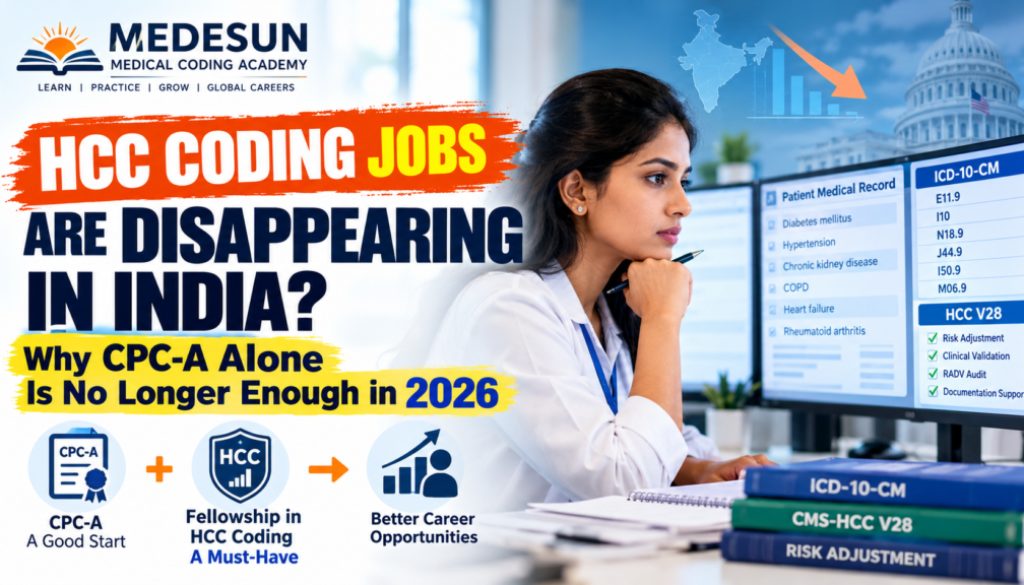
HCC Coding Jobs Are Disappearing in India? Why CPC-A Alone Is No Longer Enough in 2026
By Dr. Santosh Kumar Guptha | Founder & CEO, MEDESUN Medical Coding Academy | AHIMA-Approved ICD-10-CM/PCS Trainer
Thousands of Certified Medical Coders. But Where Are the HCC Jobs?
There was a time when completing a CPC certification and learning basic Hierarchical Condition Category (HCC) coding could help medical coders enter the U.S. healthcare outsourcing industry.
Today, many aspiring medical coders in India are asking a difficult question:
“I cleared my CPC exam. I have CPC-A certification. I learned HCC coding. Why am I still not getting interview calls?”
This is a genuine concern.
HCC coding has not disappeared. However, employers increasingly need professionals who can demonstrate practical coding knowledge, accuracy, clinical understanding and compliance awareness.
The uncomfortable reality is that passing a certification examination and becoming job-ready are two different achievements.
CPC-A is a starting point. Specialized HCC competency is the next step.
1. Why Are HCC Coding Jobs Difficult to Find in India?
Several factors may explain the challenges facing HCC job seekers.
Changing project requirements: HCC outsourcing demand depends on U.S. health-plan contracts, chart-review volumes, coding seasons and client budgets.
Experienced coders preferred: Employers may favor candidates who have already worked on medical records and understand coding accuracy standards.
AI-assisted workflows: Technology can help identify diagnoses and prioritize charts, potentially increasing productivity expectations.
Greater compliance scrutiny: Coding teams must pay close attention to documentation support, coding guidelines and audit readiness.
More candidates competing: As interest in medical coding increases, candidates without practical specialization can struggle to differentiate themselves.
There is insufficient public evidence to conclude that HCC jobs are disappearing nationwide. However, the hiring challenges reported by applicants deserve serious attention.
2. HCC V28 Has Changed the Skills Coders Need
The Centers for Medicare & Medicaid Services (CMS) completed its three-year implementation of the updated CMS-HCC risk-adjustment model for calendar year 2026.
For applicable Medicare Advantage organizations, CMS calculates 100% of relevant risk scores using the updated 2024 CMS-HCC model, commonly called V28.
This means HCC coders need to understand much more than diagnosis code selection.
They should know how to:
-
Apply ICD-10-CM Official Guidelines for Coding and Reporting.
-
Understand differences between CMS-HCC V24 and V28.
-
Identify diagnoses relevant to risk adjustment.
-
Review provider documentation and supporting clinical evidence.
-
Recognize unsupported, conflicting or insufficient documentation.
-
Understand applicable risk-adjustment data-submission requirements.
-
Identify when compliant documentation clarification is appropriate.
-
Support coding quality reviews and audits.
A coder who knows how to select a diagnosis code is useful. A coder who can accurately interpret documentation, defend coding decisions and identify compliance risks offers additional value.
3. CPC-A Alone Is Not Enough: Why Specialization Matters
The CPC credential demonstrates foundational knowledge in medical coding, particularly physician and outpatient coding.
The CPC-A designation indicates apprentice status.
Neither CPC nor CPC-A should be dismissed. Both can provide valuable career foundations.
However, CPC-A certification does not, by itself, demonstrate advanced proficiency in Medicare Advantage risk adjustment, HCC coding, clinical validation or RADV audits.
This is why MEDESUN recommends developing a specialized skill set rather than depending exclusively on an entry-level credential.
RECOMMENDED CAREER DEVELOPMENT PATH
CPC / CPC-A
Foundational coding knowledge
FIMC-HCC® Fellowship Training
Specialized HCC education and case practice
Practical HCC Coding and Auditing Skills
Chart review, documentation support and V28
HCC Coder / QA / RADV Career Opportunities
Subject to employer requirements and vacancies
4. Why a Fellowship in HCC Coding Is a Must-Have Skill Development Priority
For CPC-A holders who want to build a career specifically in HCC coding, specialized fellowship-level training should be treated as an important next step.
General certification prepares candidates for broad coding responsibilities. Specialized HCC training allows them to concentrate on the knowledge required for risk adjustment.
A well-structured HCC fellowship should teach:
| Competency | Why it matters |
|---|---|
| ICD-10-CM coding accuracy | Helps prevent incorrect diagnosis assignment |
| CMS-HCC V28 | Supports understanding of current risk-adjustment methodology |
| Clinical documentation review | Helps verify diagnosis support |
| Chronic condition coding | Builds competence in complex patient records |
| Practical chart abstraction | Develops application skills beyond multiple-choice questions |
| RADV awareness | Introduces audit and documentation requirements |
| Coding quality assurance | Builds analytical and error-identification skills |
| AI-assisted coding review | Prepares coders to evaluate technology-supported outputs |
Fellowship training is particularly valuable when it includes genuine case practice, feedback and competency assessment.
Nevertheless, an HCC fellowship is not a government-mandated qualification or a universal employer requirement. What matters ultimately is whether candidates can demonstrate the skills employers need.
5. Introducing FIMC-HCC® — Fellowship in HCC Coding
MEDESUN Medical Coding Academy recommends the FIMC-HCC® Fellowship in HCC Coding, a proprietary professional education and credentialing program offered by PMBAUSA LLC.
The fellowship is designed to help medical coders strengthen their specialization in risk-adjustment coding.
Its educational focus includes:
-
HCC coding fundamentals and CMS-HCC model concepts.
-
ICD-10-CM diagnosis coding in risk-adjustment contexts.
-
V24 versus V28 concepts.
-
Clinical documentation interpretation.
-
Risk-adjustment coding accuracy.
-
Practice using simulated patient records.
-
Coding compliance and audit fundamentals.
The program includes self-paced learning and practice involving approximately 50 medical records.
FIMC-HCC is an additional specialization credential, not a replacement for CPC, CRC, CCS or employer-required experience.
The purpose is not merely to add another certificate to your résumé. It is to become a more competent HCC coding professional.
For program information, visit www.pmbausa.com or www.medesunglobal.com.
6. The Future Is Not Just HCC Coding — It Is HCC Coding, Auditing and AI
One of the most significant developments in Medicare Advantage is the increased attention to risk-adjustment audits.
In May 2025, CMS announced an expanded RADV audit strategy, including plans for wider contract audits, advanced technology and additional coding-review resources.
CMS also initiated payment-year 2024 RADV audits in August 2026.
These developments reinforce the importance of accurate clinical documentation and diagnosis validation.
Future-oriented HCC professionals should therefore develop capabilities in three overlapping areas:
HCC coding: Correctly interpret documentation and assign supported ICD-10-CM diagnoses.
HCC auditing: Evaluate coding accuracy, documentation sufficiency and compliance with applicable rules.
AI-assisted quality review: Understand how AI tools identify potential diagnoses, recognize their limitations and validate outputs against medical records.
AI is not an excuse to abandon medical coding knowledge. It creates a stronger reason to understand coding rules and documentation.
A coder who cannot recognize an incorrect AI-generated diagnosis may have difficulty performing meaningful quality assurance.
7. Advice to CPC-A Holders: What Should You Do Next?
If you recently passed your CPC examination and are struggling to find an HCC coding job, consider this practical approach.
1. Strengthen ICD-10-CM skills. Study official coding guidelines and become confident in assigning and sequencing diagnoses.
2. Choose a specialization. If your goal is risk adjustment, pursue structured HCC training or fellowship-level education.
3. Practice real-world scenarios. Work through de-identified or simulated medical records rather than relying entirely on MCQs.
4. Learn V28 thoroughly. Understand condition categories, documentation requirements and the differences from previous models.
5. Learn basic auditing. Practice identifying unsupported diagnoses, incorrect code assignments and documentation gaps.
6. Build AI literacy. Learn to evaluate AI-generated coding suggestions without assuming they are correct.
7. Prepare for employer coding assessments. Demonstrate how you reached each coding decision, not just the final answer.
Remember, neither a certification nor a fellowship guarantees placement. Employers evaluate technical assessments, experience, communication, accuracy and project requirements.
8. A Message from Dr. Santosh Kumar Guptha
Over more than two decades of medical coding education and professional training, one lesson has remained important:
Certifications can demonstrate knowledge. Practical competence helps sustain a career.
My advice to aspiring HCC coders is simple.
Do not stop learning after passing the CPC examination.
Do not assume CPC-A alone will qualify you for every HCC coding position.
And do not confuse collecting certificates with developing professional expertise.
If you want to specialize in HCC coding, invest in structured education, extensive practice, documentation review and coding compliance.
A Fellowship in HCC Coding can provide a useful framework for that journey.
But your real professional value comes from applying what you learn.
In the changing medical coding industry, your next opportunity may depend less on how many credentials you hold and more on what you can actually do with them.
Conclusion: CPC-A Is the Beginning. HCC Fellowship Training Can Be the Next Step.
The Indian medical coding employment market is competitive, and applicants cannot rely on certification alone to distinguish themselves.
For those interested in Medicare Advantage risk adjustment, specialized HCC knowledge is increasingly relevant.
A structured fellowship can help bridge foundational coding education and advanced HCC competencies, provided it offers substantive training and practical assessment.
Don’t be just CPC-A certified. Become HCC-skilled, audit-aware and AI-ready.
Explore HCC education and specialization opportunities through MEDESUN Medical Coding Academy and PMBAUSA LLC.
MEDESUN Medical Coding Academy: https://www.medesunglobal.com
PMBAUSA LLC: https://www.pmbausa.com
References
Disclaimer
This article is intended for educational and career-guidance purposes. Job opportunities, hiring criteria and project demand vary by employer and location. FIMC-HCC® is a proprietary, voluntary fellowship credential offered by PMBAUSA LLC. It is not issued, approved, accredited or endorsed by CMS, AAPC, AHIMA or any U.S. government agency. It does not replace CPC, CRC, CCS or employer-required experience, and it does not guarantee employment, career advancement or salary increases.