
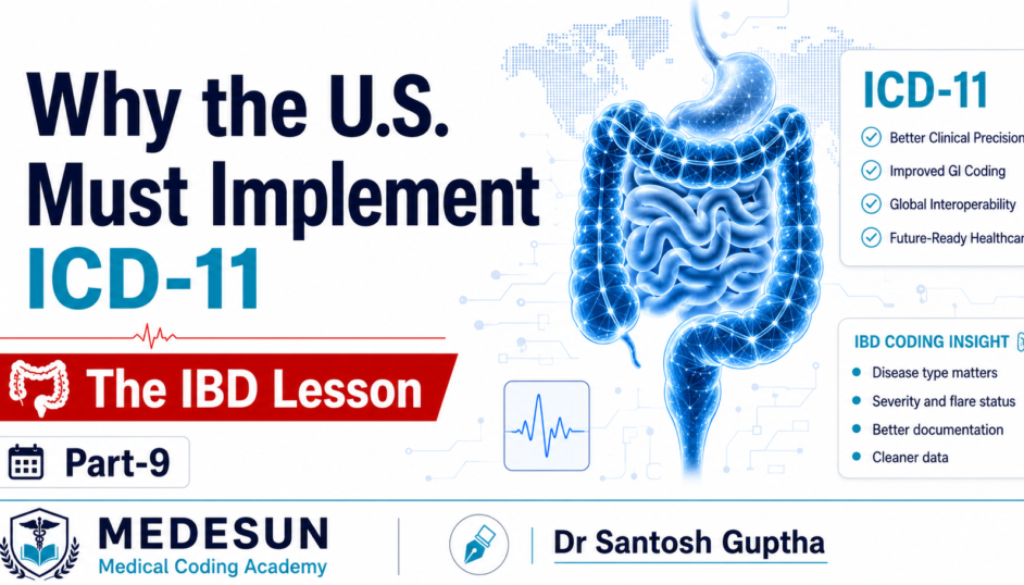
Why the U.S. Must Implement ICD-11: The IBD Lesson – MEDESUN ICD-11 Training Series
By Dr. M. Santosh Kumar Guptha · Founder & CEO, MEDESUN Medical Coding Academy – ICD-11 Training Series
Across this series, I have shown how ICD-10-CM repeatedly loses clinical information that ICD-11 preserves — the rhythm of a cardiac arrest, the phenotype of asthma, the cause of gastritis. Inflammatory bowel disease (IBD) adds a different and, in some ways, more interesting lesson. Here, the two systems each do something the other cannot — and understanding that trade is exactly why the United States should begin preparing for ICD-11 thoughtfully, rather than treat it as a simple swap.
The question a gastroenterologist asks first: where?
When a patient has Crohn’s disease, one of the most consequential facts is where in the digestive tract the disease lives. Crohn’s can affect anything from the mouth to the anus, and the location drives treatment: perianal Crohn’s often requires biologic therapy and surgical management; upper-gastrointestinal Crohn’s carries its own prognosis; disease recurring at a previous surgical join (an anastomosis) is a recognized, distinct clinical problem.
Now consider what ICD-10-CM allows you to record. Its Crohn’s category, K50, offers only four locations: small intestine, large intestine, both, or unspecified. That is the entire vocabulary.
ICD-11 expands that vocabulary substantially:
| Crohn’s location in ICD-11 (DD70) | ICD-10-CM (K50) |
|---|---|
| Upper GI tract (DD70.0) | No code — collapses into “unspecified” |
| Small intestine (DD70.1) | K50.0 ✓ |
| Appendix (DD70.2) | No code |
| Large intestine (DD70.3) | K50.1 ✓ |
| Anal / perianal region (DD70.4) | No code |
| Both small & large intestine (DD70.5) | K50.8 ✓ |
| Anastomotic sites (DD70.6) | No code — post-procedural codes only |
Four clinically important locations — upper GI, appendix, perianal, and anastomotic recurrence — simply have no home in ICD-10-CM. The disease exists in the patient; it does not exist in the data.
An honest counterpoint: where ICD-10-CM is actually stronger
I want to be fair, because credibility matters more than cheerleading. On one axis, ICD-10-CM is genuinely richer than ICD-11’s base code.
Every ICD-10-CM IBD code carries a built-in complication layer: with rectal bleeding, with intestinal obstruction, with fistula, with abscess. That detail sits right in the code. ICD-11 captures the same information through post-coordination — adding a second code to the cluster — rather than on the stem itself.
So the contrast is not “ICD-11 is better.” It is sharper than that:
- ICD-11 tells you, more precisely, where the disease is.
- ICD-10-CM tells you, on the code itself, what the disease is doing.
A direct crosswalk therefore cannot be lossless in either direction — you lose perianal or anastomotic location going to ICD-10-CM, and you must reconstruct the complication detail coming from it. That is precisely the kind of structural nuance that makes early, careful preparation essential.
Where the two systems agree
Not everything diverges. Ulcerative colitis maps cleanly between the systems — pancolitis, left-sided colitis, rectosigmoiditis, and proctitis all have direct counterparts (DD71.0/.1/.2/.3 against K51.0/.5/.3/.2). And indeterminate colitis, the honest “we cannot yet tell Crohn’s from UC” diagnosis, exists in both (ICD-11 DD72; ICD-10-CM K52.3). Good classification design shows in these clean matches as much as in the divergences.
So why does this argue for ICD-11?
Because the gaps that ICD-10-CM cannot fill are the ones modern IBD care most depends on. Perianal Crohn’s is a biologic-therapy and surgical-decision driver. Upper-GI Crohn’s changes prognosis. Anastomotic recurrence is a defining post-surgical event. A nation that cannot code these as distinct entities cannot study them, cannot measure their outcomes, and cannot compare its IBD care with the rest of the world — even though it treats these patients expertly every day.
And none of these gaps stops a claim from paying. The IBD admission reimburses whether or not the disease’s true location is captured. That is exactly why the loss goes unnoticed: it is invisible to the revenue cycle, and therefore invisible to the institution. The cost is not financial. It is the research we cannot power and the data we never build.
What coders and CDI specialists can do now
U.S. adoption of ICD-11 will take years, and the deliberation of CMS and payers is appropriate. But the groundwork can begin today:
- Document the precise location. Specify perianal, upper-GI, appendiceal, or anastomotic Crohn’s explicitly — it already guides therapy, and it future-proofs the record.
- Keep documenting complications. Continue to capture bleeding, obstruction, fistula, and abscess, so today’s ICD-10-CM codes and tomorrow’s ICD-11 clusters are both fully supported.
- Study your crosswalks early. Map your high-volume IBD scenarios now and identify where conversion will be lossy in each direction.
The future of medical coding is not a choice between location and complication, or between reimbursement and statistics. It is the discipline to protect all of them — and the professionals who prepare for ICD-11 today will lead the transition, not chase it.
A note from Dr. Santosh Guptha: ICD-10-CM, remains a sophisticated and capable classification. Inflammatory bowel disease simply illustrates that ICD-11 and ICD-10-CM each have real strengths — and that a thoughtful transition must preserve the best of both. My respectful suggestion is unchanged: let us begin the groundwork now, through education, crosswalk study, and richer documentation, so that the profession leads the change when it arrives.
Dr. M. Santosh Kumar Guptha is the Founder and CEO of MEDESUN Medical Coding Academy, an AHIMA-approved training institution, and writes the ongoing “Why the U.S. Must Implement ICD-11” series on ICD-11 readiness, clinical documentation integrity, and the future of medical coding education. Learn more at medesunglobal.com.