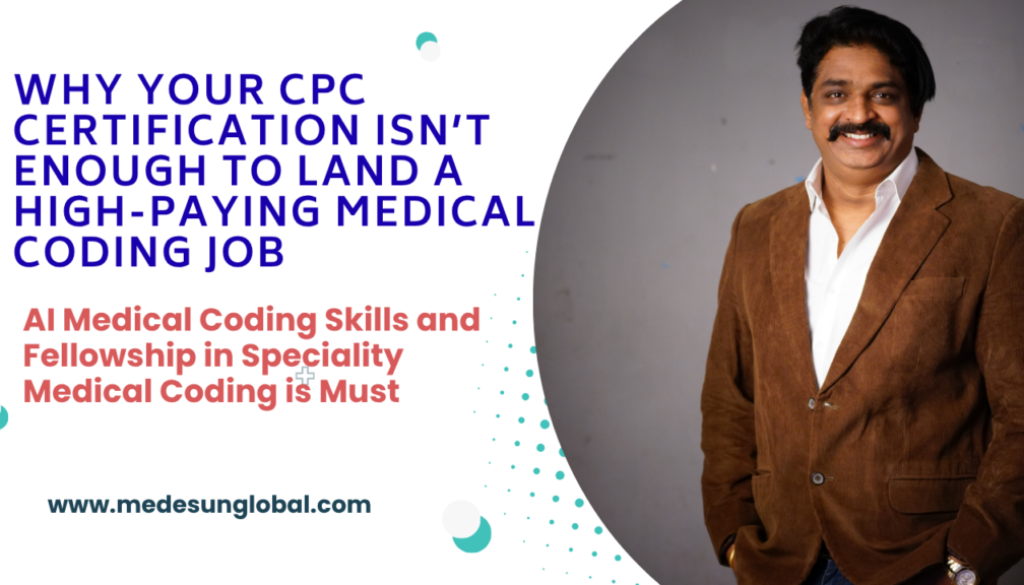
Why Your CPC Certification Isn’t Enough to Land a High-Paying Medical Coding Job
The Hard Truth the Industry Isn’t Telling You — And What Actually Pays in 2026
Founder & CEO, MEDESUN Medical Coding Academy | 22+ Years in Medical Coding
Let me say something that will offend a lot of training institutes, recruiters, and maybe even you: your CPC certification, by itself, is no longer a golden ticket.
It was, once. A decade ago, adding “CPC” after your name was enough to open doors at RCM companies across Hyderabad, Chennai, Bangalore, and beyond. Hiring managers were hungry. Seat counts were exploding. Freshers were placed within weeks of certification.
That world is gone.
In 2026, I am still seeing CPC-certified candidates — many of them intelligent, sincere, and genuinely hardworking — sitting at home for six, nine, even twelve months after certification. They stare at their AAPC certificate on the wall and wonder what went wrong. They did everything the coaching center told them to do. They passed the exam. They paid the membership fee. And yet the high-paying job never came.
After 22 years in medical coding and training thousands of coders across India, the U.S., and the Middle East, I can tell you exactly what went wrong — and more importantly, what it takes today to actually get hired and actually get paid.
1. The CPC Has Been Commoditized
Let’s start with supply and demand.
When I wrote my first CPT code in 2004, passing the CPC was genuinely rare. Today, India alone produces tens of thousands of CPC-certified candidates every year. Dubai, the Philippines, and Latin America are adding thousands more. Recruiters are no longer impressed by the three letters on your resume — they assume you have them.
Think of it like the MBA in the early 2000s versus today. Holding an MBA used to guarantee a management seat. Now it’s the floor, not the ceiling. CPC is the new floor.
If everyone in the interview room has a CPC, the person who gets hired is the person who offers something more. The question is no longer “Are you certified?” The question is “What else can you do?”
2. What Employers Actually Want in 2026 (That CPC Doesn’t Teach You)
I have reviewed hiring rubrics from some of the largest U.S. RCM companies and Indian captives. The CPC syllabus touches perhaps 40 percent of what they screen for. The other 60 percent — the part that separates a ₹ 22,000/month junior coder from a ₹ 80,000+/month specialty coder — is almost entirely missing from standard CPC prep.
Here is what employers are really screening for:
- Specialty-specific chart reading. Your ability to read a real operative report, discharge summary, or ED note and assign accurate codes without hand-holding. Exam-style vignettes do not prepare you for a 12-page spine surgery op note.
- Payer-specific reimbursement rules. Medicare NCCI edits, LCD/NCD logic, MUE, global period rules, modifier 25/59/XE/XS/XP/XU, modifier 22/52/53/62/66/80. Most CPC graduates can recite modifier definitions but cannot apply them in an audit scenario.
- E/M 2021/2023 guidelines and MDM-driven leveling. Most CPC holders cannot independently review a physician’s note, assign the correct MDM level under the 2021/2023 AMA guidelines, and defend that level to an OIG-style auditor. This single skill is worth ₹ 20,000–30,000 more per month.
- Denial management and appeals writing. Employers have lost trust in coders who only know denials superficially. They want people who can read a 277CA, CARC/RARC codes, appeal letters, and actually recover revenue.
- Inpatient coding and DRG optimization. ICD-10-PCS, MS-DRG and APR-DRG logic, CC/MCC capture, present-on-admission indicators. This is where CCS-level knowledge begins — and where the real money lives.
- Compliance and ethics. HIPAA, HITECH, OIG work plan priorities, False Claims Act, Anti-Kickback Statute. If you cannot explain why a coder can go to prison, you are not ready for a senior role.
- AI-assisted coding literacy. In 2026, you must be fluent with Computer-Assisted Coding platforms, understand how NLP suggests codes, know the difference between discriminative and generative AI in coding workflows, and understand where the coder still owns liability when AI suggests a wrong code.
Notice something? Not one of these is emphasized deeply in a typical CPC prep program. They are the curriculum of a coder, not a test-taker.
3. The “Intellectual Obesity” Trap
I have written and spoken about this for years. Many medical coders today are suffering from what I call Intellectual Obesity — they have consumed enormous quantities of training content, watched hundreds of hours of YouTube videos, bought multiple exam prep bundles, collected certification after certification — and yet cannot perform the actual job.
They are full but not nourished.
A coder who has genuinely mastered 500 operative reports will out-earn a coder with five certifications and no real chart exposure. Every single time.
High-paying employers do not pay for what you have memorized. They pay for what you can produce under deadline, under audit pressure, and under payer scrutiny. That capacity is built only through supervised, realistic chart practice — not multiple-choice drills.
4. What High-Paying Jobs Actually Look Like — And What They Demand
Let’s be specific about what “high-paying” means in the Indian medical coding market in 2026:
- Junior coder (₹ 18,000–25,000/month): Typically held by CPC-only candidates with 0–1 year of experience. This is the entry floor.
- Specialty coder (₹ 35,000–55,000/month): Usually requires CPC plus demonstrable accuracy above 95 percent on live charts, plus one or two specialties (IP/OP surgery, cardiology, orthopedics, radiology).
- Inpatient / DRG coder (₹ 55,000–90,000/month): Requires CCS or CIC, strong ICD-10-PCS, MS-DRG expertise, and CDI awareness. Almost impossible to reach with CPC alone.
- Auditor / QA (₹ 60,000–1,20,000/month): Requires CPMA or equivalent auditing discipline, E/M mastery, denial expertise, and the ability to write audit reports that stand up to OIG-style scrutiny.
- CDI specialist (₹ 70,000–1,40,000/month): Requires CDIP or CCDS, deep clinical knowledge, query-writing skills under ACDIS/AHIMA ethical standards, and the ability to communicate with physicians as equals.
- Trainer / SME / AI-coding lead (₹ 1,00,000+/month): Requires a portfolio — trainer experience, published content, AI literacy, and ideally advanced credentials such as CCS, CPMA, CDIP, CRC, or the emerging CAIMC® (Certified AI Medical Coder).
The pattern is unmistakable: the compensation curve bends upward precisely where the CPC curriculum ends.
5. The AI Disruption Nobody Wants to Talk About Honestly
I will be blunt. Computer-Assisted Coding and generative AI are absorbing the routine, low-complexity coding work that used to be the training ground for juniors. Simple E/M, straightforward radiology, clean ancillary services — large language models now suggest these codes with reasonable accuracy.
This is not a future threat. It is happening on production floors right now.
What this means for a new CPC holder is brutal but important to accept: the bottom rung of the ladder is being automated away. If your skill set looks like what a CAC tool can already do, you are not competing with other coders — you are competing with software that works 24/7 and never asks for a raise.
The coders who will thrive are the ones who position themselves exactly where AI is still weak: ambiguous documentation, complex surgical cases, denial defense, audit reasoning, CDI queries, and coder-on-the-loop validation of AI-suggested codes. That is why, at MEDESUN, we launched the CAIMC® (Certified AI Medical Coder) program — not to replace traditional credentials, but to equip coders for the workflow that is actually being built around them.
6. So What Should You Actually Do?
If you are a CPC holder who is underemployed or unemployed, here is the honest, field-tested roadmap I give my own students:
Step 1 — Accept the diagnosis.
The certificate alone will not rescue you. Stop blaming the market, the recruiters, or “reservations.” The problem is a skills gap, and skills gaps can be closed.
Step 2 — Build specialty depth.
Pick one or two specialties — cardiology, orthopedics, radiology, or E/M — and code hundreds of real charts in that area under supervision. Depth pays. Breadth without depth does not.
Step 3 — Add one credential that solves a real employer problem.
CPMA for auditing. CRC for risk adjustment and HCC. CCS for inpatient and hospital outpatient. CDIP for CDI. CAIMC® for AI-coding fluency. Pick based on where you want to be in three years, not where the cheapest course is.
Step 4 — Learn to read a denial.
Practice with real CARC/RARC codes, real 835/837 files, real appeal scenarios. A coder who recovers revenue is a coder who keeps the job through any downturn.
Step 5 — Develop a portfolio, not a certificate wall.
Redacted chart samples you have coded. Audit reports you have written. Query letters you have drafted. This is what senior hiring managers want to see. Certificates get you an interview. A portfolio gets you the offer.
Step 6 — Get AI-literate, not AI-afraid.
Understand how CAC tools work, where they fail, and how to validate their output. The coder who can audit an AI’s suggestions is far more valuable than the coder who is merely faster than the AI.
CPC certification is still worth earning. It is a foundation, a professional credential, and a statement of intent. But it is not, and never was, a career by itself.
If you treat the CPC as a finish line, you will keep waiting for a job that is not coming. If you treat it as a starting line — a license to begin the real work of becoming a coder — you will find that the high-paying opportunities have not disappeared at all. They have simply moved, as they always do, toward those who keep learning after the ceremony is over.
Certificates hang on walls. Skills pay salaries. Decide which one you are building.
Twenty-two years in, that is still the truest sentence I know about this profession.
About the Author
Dr. Santosh Guptha, is the Founder and CEO of MEDESUN Medical Coding Academy, an AHIMA-Approved Training Institution. With 22+ years in medical coding and approximately 45 professional credentials across AAPC and allied health bodies, he has trained thousands of medical coders across India, the U.S., and the Middle East. He is the creator of the CAIMC® (Certified AI Medical Coder) credential and the originator of the “Intellectual Obesity in Medical Coding” framework.
Ready to move beyond the CPC ceiling?
Explore specialty coding, CCS, CPMA, CDIP, and CAIMC® programs at
www.medesunglobal.com
Disclaimer
CPC® is a registered trademark of AAPC. CCS®, CDIP®, and RHIA® are registered trademarks of AHIMA. CAIMC® is a credential privately awarded by PMBAUSA LLC / MEDESUN Medical Coding Academy and is not affiliated with, endorsed by, or recognized by AAPC, AHIMA, or any government body. Salary ranges mentioned are indicative market observations as of 2026 and may vary by employer, location, and individual experience. This article reflects the professional opinion of the author based on 22+ years of field experience and is intended for educational and career-guidance purposes.