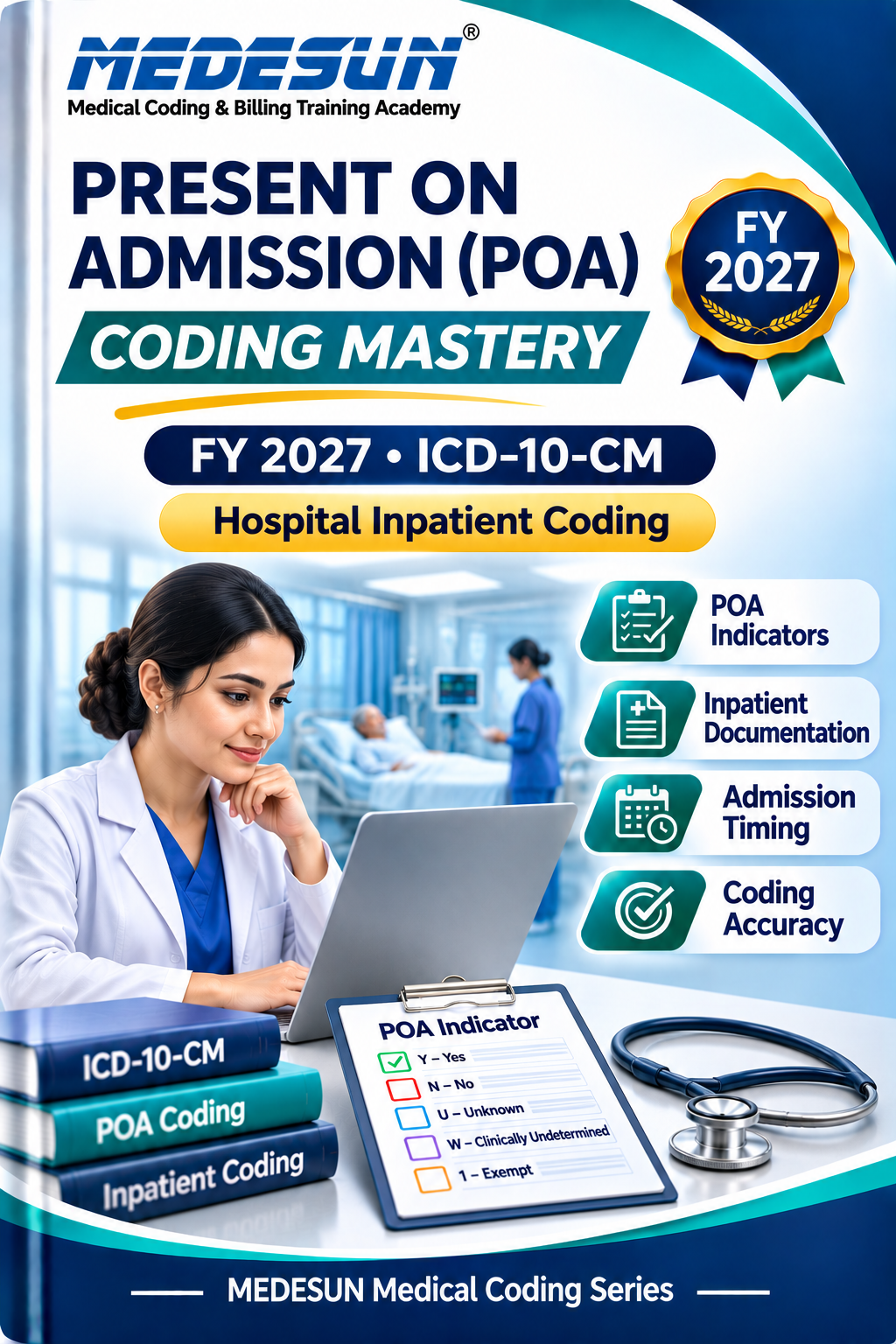
Distinguish Y, N, U, W, and exempt reporting, and understand the meaning of each indicator.
1
Establish Admission Timing
Compare conditions present at the time the inpatient admission order occurs with conditions arising later in the hospital stay.
2
Review Inpatient Documentation
Use provider documentation and the record timeline to support POA assignments; identify ambiguity that requires clarification.
3
Evaluate Uncertain Diagnoses
Apply the official guidance for diagnoses documented as uncertain at discharge and distinguish coding from POA determination.
4
Check POA-Exempt Conditions
Confirm whether a diagnosis is exempt from POA reporting using the current official exemption list rather than assigning an indicator automatically.
5
Improve Accuracy and Validation
Review conflicting information, documentation queries, principal/secondary diagnoses, and audit findings before finalizing claims.
6
FY 2027 coding note: Check the current official ICD-10-CM guidelines, POA-exempt list, and applicable CMS reporting requirements. A POA indicator does not itself establish a hospital-acquired condition for quality-program purposes.
Learn beyond the book
Strengthen Your Inpatient Coding Skills
Use this guide to develop documentation-based reasoning for POA indicators and explore MEDESUN training for broader ICD-10-CM and CCS-focused inpatient coding skills.
CPT® and CPC® are registered marks of their respective owners. MEDESUN is an independent training provider; the presence of credential names does not imply endorsement.
Request course information
Enquire About Inpatient Coding & CCS Training
Looking for instructor-guided ICD-10-CM diagnosis coding, inpatient documentation or CCS preparation? Contact MEDESUN for available course details.