In ICD-10-CM, the code for a left-sided fracture already contains the word “left”. In ICD-11, “left” is its own code. That one design decision changes how every coder thinks.
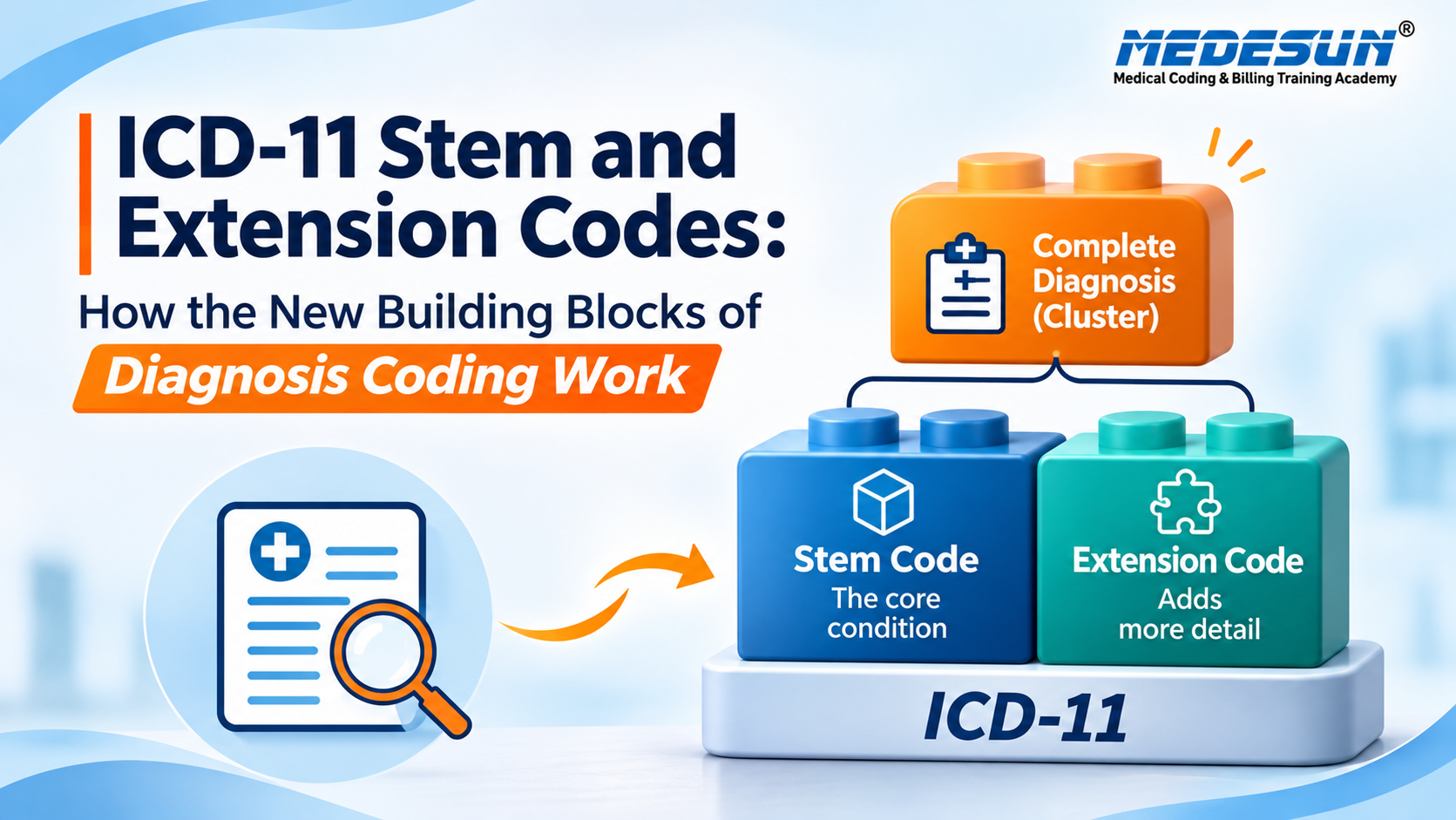
Stem codes and extension codes are the building blocks of ICD-11. Understand them well and the rest of the system falls into place.
What is a stem code?
A stem code is a code from the main chapters of ICD-11 MMS that can be used on its own. Examples include 5A11 (type 2 diabetes mellitus), BA00 (essential hypertension), 1D21 (dengue with warning signs) and 1B10.0 (respiratory tuberculosis, confirmed). ICD-11 stem codes are alphanumeric, and their first character indicates the chapter: 1 for infectious diseases, 5 for endocrine and metabolic, B for circulatory, and so on.
What is an extension code?
Extension codes live in Chapter X and always begin with X. They add detail to a stem code and can never be used alone or placed first in a cluster. ICD-11 uses them so that it does not need thousands of extra pre-built codes for every combination of side, severity or anatomy.
What kinds of extension codes exist?
| Extension type | What it adds | Example |
|---|---|---|
| Laterality | Side of the body | XK9K right, XK8G left, XK9J bilateral |
| Severity | Mild, moderate, severe | Added where the stem allows a severity axis |
| Temporality and course | Acute, chronic, onset timing | Used where documented |
| Anatomy and topography | Specific site | Detailed anatomical location |
| Histopathology | Tumour morphology | Used with neoplasm stem codes |
| External causes | Mechanism, place, activity | XE266 place of occurrence: home |
| Substances and devices | Drugs, chemicals, medical devices | Used for harm and injury detail |
How do stem and extension codes combine?
An extension attaches to its stem with an ampersand: NC72.30&XK9K means intertrochanteric fracture of femur, right side. A second stem code attaches with a slash: 9B71.01&XK8G/5A11 means proliferative diabetic retinopathy, left eye, caused by type 2 diabetes mellitus. Each stem code carries its own extensions.
What errors should coders avoid?
- Starting a cluster with an extension code.
- Using two values from the same axis, for example both mild and severe.
- Adding an extension the stem does not allow. The WHO Coding Tool shows the allowed axes for each stem.
- Assuming laterality or severity the documentation does not state.
How can I learn this hands-on?
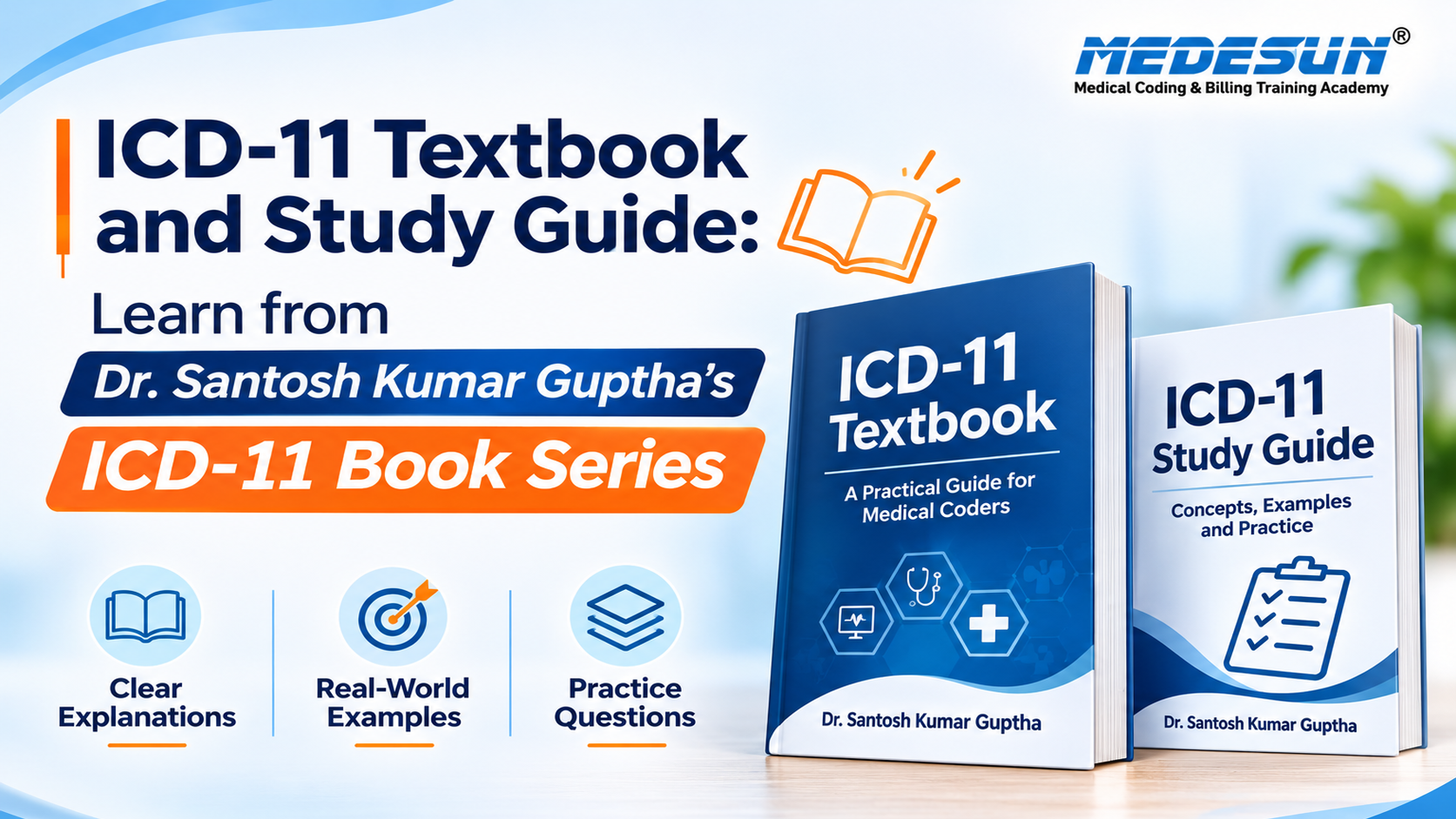
Dr. Santosh Kumar Guptha’s ICD-11 textbooks explain stem and extension logic chapter by chapter, with worked clusters. MEDESUN’s ICD-11 course applies that logic to real Indian clinical records under trainer review.
Who is Dr. Santosh Kumar Guptha?
About the Author
Dr. M. Santosh Kumar Guptha is the Founder and CEO of MEDESUN® Medical Coding Academy and PMBAUSA LLC, and a first-generation AHIMA-Approved ICD-10-CM/PCS and ICD-11 Trainer, trained by CBHI (Central Bureau of Health Intelligence, Government of India) and WHO India.
With 22+ years in medical coding, 43 professional certifications since his CPC® in 2004 (including CCS®, CPC®, CPMA®, CDIP®, CRC®, CIC®, COC® and HIMAA ICD-10-AM Level 1), more than 30,000 professionals trained globally, oversight of coding on about one million records, and nearly seven years working with physicians across Florida, New Jersey, New York, Texas and California, he brings bedside-to-claim experience to every ICD-11 lesson.
ICD-11 books by Dr. Santosh Kumar Guptha:
ICD-11 MMS Comprehensive Textbook (600+ pages)
ICD-10-CM to ICD-11 Transition Textbook: chapter-by-chapter comparative analysis
ICD-11 vs ICD-10-CM Comparative Reference Workbook (200 questions with rationales)
How ICD-11 Will Transform U.S. Healthcare: From Diagnosis Coding and CDI to Reimbursement and Data Analytics (forthcoming)
Frequently Asked Questions (FAQs)
No. Extension codes always follow a stem code.
The WHO ICD-11 Browser and Coding Tool show the permitted postcoordination axes for each stem code.
To keep the stem code list lean while still allowing rich detail, instead of pre-building every possible combination.
No. Chapter X contains supplementary extension codes, not diseases.

Train with MEDESUN®
Ready to lead the ICD-11 transition?
ICD-11 is not learned by memorising codes. It is learned by understanding the patient behind the record. That is the heart of MEDESUN's "Intellectual Obesity in Medical Coding" philosophy: clinical reasoning over memorisation.
Whether you are a hospital medical records team, an insurer or TPA, a health-tech company or an individual coder, MEDESUN's ICD-11 programmes, led personally by Dr. Santosh Kumar Guptha, will prepare you to code ICD-11 accurately, defend it in an audit, and lead your organisation's transition.