Master POA & HAC Coding for AHIMA CCS & CDIP Exam Preparation
Download Your FREE POA & HAC Coding Guide
Understand Present on Admission (POA), Hospital-Acquired Conditions (HAC), POA indicators, MS-DRG impact, CDI documentation, and high-yield CCS/CDIP exam concepts.
This practical MEDESUN guide is designed to help AHIMA CCS and CDIP exam candidates, inpatient coders, CDI professionals, HIM professionals, and healthcare professionals understand how POA and HAC reporting affect coding, reimbursement, documentation, and quality measurement.
What Is Present on Admission (POA)?
Present on Admission (POA) identifies whether a condition was present at the time the inpatient admission order occurs.
Conditions that develop during an ED, observation, or outpatient surgery encounter before the inpatient admission order are also considered POA.
POA is reported after the final ICD-10-CM codes have been determined. It does not determine whether a condition should be coded.
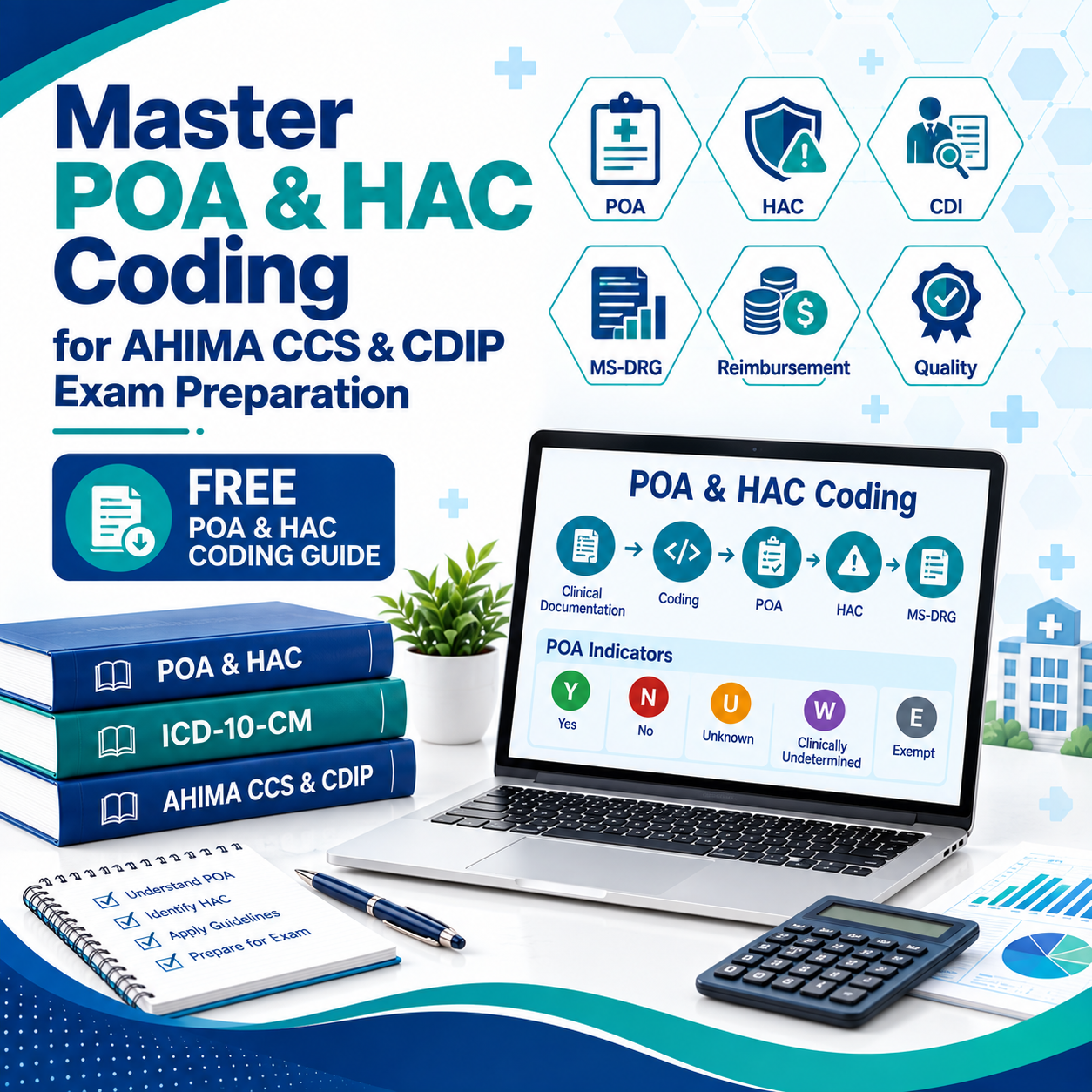
The guide covers the five POA outcomes:
- Y – Present on Admission
- N – Not Present on Admission
- U – Documentation insufficient to determine
- W – Clinically undetermined by the provider
- Exempt/Blank – POA field left blank for applicable exempt codes
What You Will Learn From This Guide
Understand:
- POA definition and reporting requirements
- When ED, observation, and outpatient conditions qualify as POA
- POA indicators Y, N, U, W, and Exempt
- The difference between coding and POA assignment
Learn how to handle:
- Chronic conditions
- Acute conditions and exacerbations
- Suspected or probable diagnoses
- Infections and delayed culture results
- Obstetrical and perinatal conditions
- Congenital conditions
- External cause codes
- Codes representing multiple clinical concepts
Understand the 8 CMS-selected HAC categories, including:
- Pressure ulcers
- Vascular catheter-associated infections
- Hospital-acquired injuries
- CAUTI
- Mediastinitis after CABG
- Retained foreign body
- Air embolism
- Blood incompatibility reaction
Learn how a HAC with POA = N or U can affect MS-DRG assignment when the HAC is the relevant CC/MCC driving the higher-weighted DRG.
The guide also includes real-world financial examples demonstrating the potential reimbursement impact of POA determination.
Learn how CDI professionals can address:
- Unclear POA documentation
- Conditions documented after admission
- HAC-related documentation
- Physician clarification queries
- Pressure ulcer documentation challenges
Review high-yield concepts and practice scenarios involving:
- Y / N / U / W
- Exempt codes
- Chronic conditions
- HACs
- DRG impact
- Documentation timing
- CDI query strategies
Why Is POA & HAC Important for CCS/CDIP?
Understanding POA and HAC helps professionals connect:
Clinical Documentation → Coding → POA Assignment → HAC Identification → MS-DRG → Reimbursement
Accurate POA documentation is particularly important for HAC reporting, DRG assignment, reimbursement, CDI, quality measurement, and exam preparation.
The guide also emphasizes a critical concept for both CCS and CDIP:
POA does not determine whether a condition should be coded. Code first, then assign POA.
Key Takeaways From the Guide
By studying this guide, you will understand:
Who Should Download This Guide?
This guide is useful for:
Why Download the MEDESUN Case Mix Index Guide?
Exam-Focused Learning
Practical Examples
Simplified Comparison
CDI & Reimbursement Connection
Created by Medical Coding Educators

About the Author, Dr. M. Santosh Kumar Guptha
Dr. Santosh Kumar Guptha is the Founder and CEO of MEDESUN Medical Coding Academy, PMBAUSA LLC, and SunRCM. He is a globally recognized medical coding master trainer with:
“In my 22 plus years teaching this field, I have never met a student who followed a structured 60-day plan and failed the CPC. Never.” Dr. Santosh Kumar Guptha
Frequently Asked Questions
POA means Present on Admission and identifies whether a condition was present when the inpatient admission order occurred.
The primary POA indicators are Y, N, U, W, and Exempt/Blank.
Y means the condition was present at the time of inpatient admission.
N means the condition was not present at admission and developed during the inpatient hospitalization.
U means the documentation is insufficient to determine whether the condition was present on admission.
W means the provider is clinically unable to determine whether the condition was present on admission.
HACs are selected conditions identified by CMS for which applicable POA and payment rules can affect Medicare reimbursement.
No. The guide emphasizes that coding is completed first and POA is assigned afterward.
Yes. The guide includes high-yield POA rules, HAC concepts, CDI strategies, and practice scenarios specifically for CCS/CDIP preparation.
Yes. The guide is offered as a free educational resource from MEDESUN.
Ready to Master POA & HAC Coding?
Strengthen Your AHIMA CCS & CDIP Exam Preparation
Understand POA indicators, HACs, CDI documentation, MS-DRG impact, and high-yield exam concepts with this practical MEDESUN guide.
Download your FREE POA & HAC Coding Guide today.