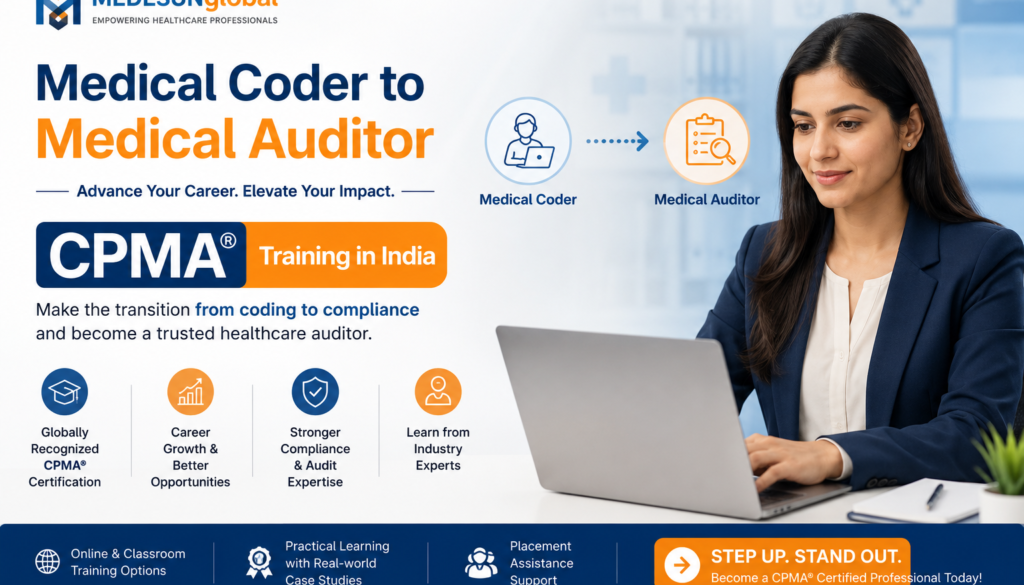
Medical Coder to Medical Auditor | CPMA® Training in India | MEDESUN
Two coders join the same company on the same day.
Five years later, one is still coding charts and asking for a 12% hike. The other reviews that first coder’s work, signs the audit report, and sits in the meeting where the client is told what has to change.
Same starting point. Same certification. Same years.
One of them upgraded.
What Actually Separates a Coder From an Auditor?
Not speed. Not code knowledge. Not how many credentials sit after your name.
A coder answers one question: what code does this record support?
An auditor answers a harder one: can this organisation defend every code it has already submitted — and if not, how much is that going to cost?
That second question requires everything the first one does, plus four things most coders were never taught: statistical sampling, audit methodology, risk analysis, and the ability to write a finding that a physician will accept and a regulator will respect.
Those four skills are the entire gap. And they are teachable in weeks, not years.
Why Are Auditors in Such High Demand Right Now?
Because the federal enforcement environment stopped being theoretical.
In a May 2026 report, the OIG found that CMS potentially overpaid Medicare Advantage organisations $462 million for payment year 2021 based on unsupported acute stroke diagnosis codes — and in a sample of 97 enrollees reviewed across multiple plans, 100% of the submitted acute stroke HCC codes were not supported by the medical records.
Read that number again. Not 30%. Not 70%. Every single one.
In a separate 2026 compliance audit, the OIG found that 247 of 271 sampled enrollee-years — a 91% error rate — contained unsupported high-risk diagnosis codes. And on 11 March 2026, the Department of Justice announced a $117.7 million False Claims Act settlement with a major Medicare Advantage insurer.
Now think about what those findings mean operationally.
Every one of those organisations employed certified coders. What they lacked was somebody looking backwards — sampling their own submitted claims, finding the pattern before a federal reviewer did, and putting it in writing.
That person is an auditor. That is why they are being hired, and that is why they are paid differently.
What Does the CPMA® Syllabus Actually Cover?
Our one-month programme follows the full CPMA® content domains:
| Module | What you master |
|---|---|
| 1. Medical record standards | Documentation guidelines, legal health record, signature and authentication requirements |
| 2. Coding & documentation compliance | Where documentation fails, what auditors look for first, the defensibility test |
| 3. Coding & reimbursement concepts | E/M, surgery, HCC and risk adjustment, DRG validation from the auditor’s chair |
| 4. Scope & statistical sampling | Random vs. targeted sampling, sample size, confidence intervals, extrapolation risk |
| 5. Medical record auditing skills | Building the audit tool, scoring, error categorisation, root-cause analysis |
| 6. Quality assurance & risk analysis | Identifying patterns, prioritising risk areas, OIG Work Plan alignment |
| 7. Audit report writing & communication | Writing findings that hold up, delivering results to physicians without conflict |
Module 4 is the one that matters most and the one most self-study candidates fail. Sampling is not a coding topic — it’s a statistics topic — and it is where the exam separates prepared candidates from hopeful ones.
Why 30 Days? Isn’t That Too Fast?
It’s fast because it’s structured, and because you already have the hardest part.
You know coding. That’s five years of clinical vocabulary, guideline literacy, and chart-reading discipline that a beginner simply does not have. The CPMA® upgrade is not a new career from zero. It’s a new lens on knowledge you already own.
What’s included in the 30 days:
- Full syllabus coverage across all seven domains, taught live
- 3 full-length mock examinations under real exam timing and conditions
- 1,000-question practice bank with rationale for every answer — not just the correct one, but why each distractor is wrong
- Live audit practice on real de-identified records, because you cannot learn auditing from slides
- Report-writing workshop — the skill that gets you hired, and the one no question bank can test
The three mocks are deliberately spaced: one at the midpoint to expose your weak domain, one at week three, one before you sit. Most candidates discover their weakness is sampling or report writing. Both are fixable — but only if you find out before exam day rather than during it.
Who Is Teaching This?
Dr. M. Santosh Kumar Guptha — CPMA-certified, and holding CCS, CPC, CDIP, CRC, CIC and COC. AHIMA-Approved ICD-10-CM/PCS and ICD-11 Trainer. Twenty-two years auditing coding operations from single-physician practices to large teaching hospitals, and more than 30,000 coding professionals trained.
He holds the credential he teaches. He has also sat on the other side of the table — building audit programmes, defending findings to physicians, and explaining to hospital leadership why a pattern nobody noticed became a repayment.
That experience is what turns a syllabus into judgment.
FAQ
Am I eligible for CPMA® without prior audit experience? Yes. Coding experience is the foundation; audit methodology is taught. Two or more years of coding experience is recommended before attempting the exam.
Can I complete this while working full-time? Yes. The programme is built for working coders, with recorded sessions and flexible mock scheduling.
Do I need to already hold CPC or CCS? Not mandatory, but strongly recommended. Auditing assumes coding fluency — you should not be learning both simultaneously.
What is the salary difference between a coder and an auditor? Auditor and QA roles consistently command a premium over production coding roles in the Indian market. Figures vary by employer, city and specialty and are indicative only — verify current bands during your own job search.
Will AI replace medical auditors? Automation is expanding what needs auditing, not reducing it. Someone has to sample machine-generated output at the pattern level and sign the finding. That someone is credentialed and human.
Why MEDESUN CPMA Training Online
Anyone can sell you a question bank. Question banks teach you to recognise answers.
MEDESUN teaches you to reason — because an auditor’s real work is not recognising the right code. It’s constructing a defensible argument from a medical record, and being able to explain it to a physician who disagrees with you.
One of those people gets a certificate. The other gets the job.
Next CPMA® batch — limited seats. Enquire at medesunglobal.com.
Disclaimer: MEDESUN Medical Coding Academy is an independent training provider. CPMA® is a registered trademark of AAPC. This programme is exam-preparation training and is not endorsed by, affiliated with, or approved by AAPC, AHIMA, CMS, AMA, or any government body. Salary and market references are indicative and should be independently verified. Enforcement figures cited are drawn from published OIG and DOJ releases as of the date of publication.