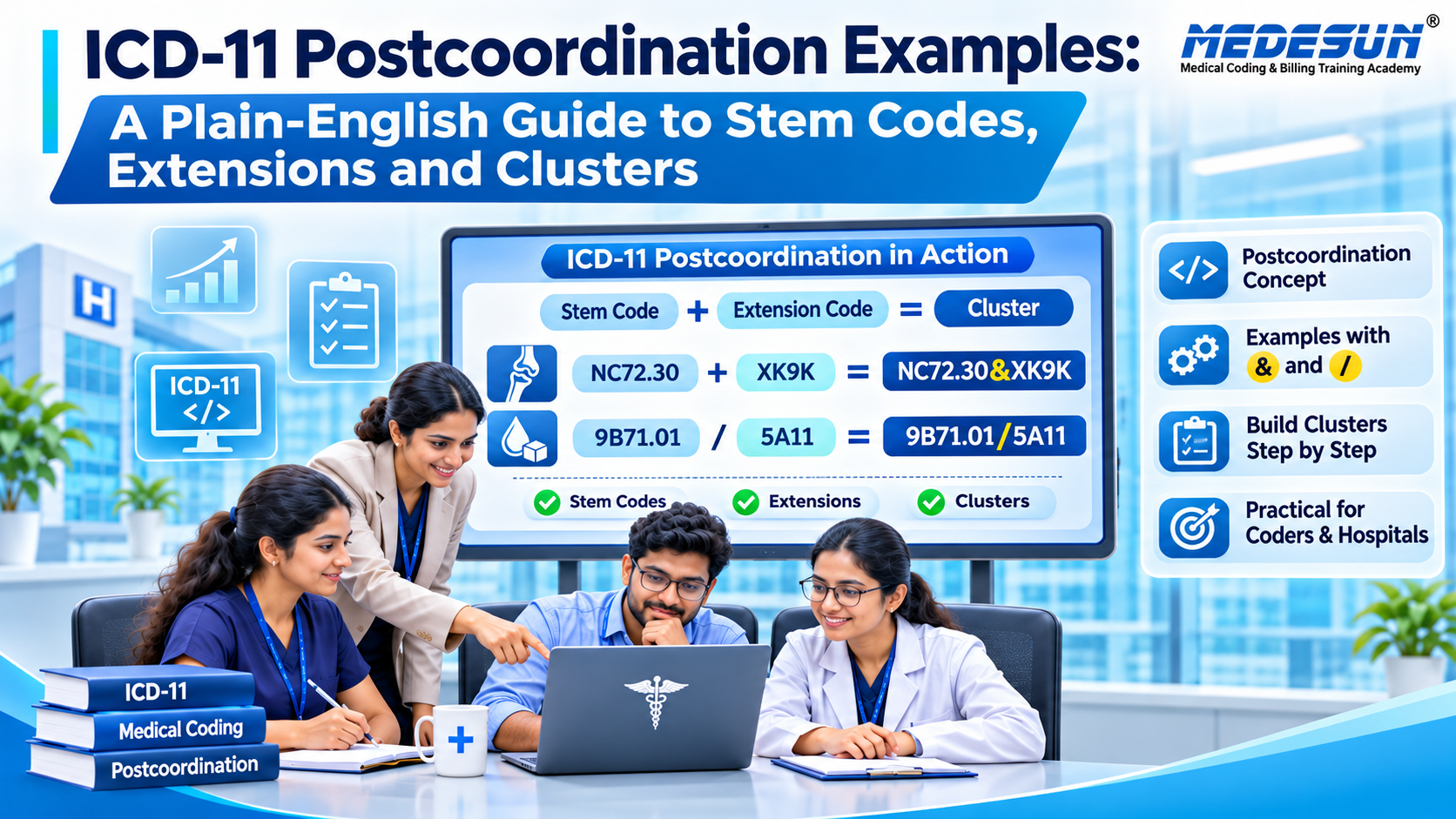
If ICD-10 was a dictionary, ICD-11 is a grammar. In ICD-10 you looked for the one word that matched. In ICD-11 you can build a sentence: this condition, on this side, of this severity, caused by this, in this place.
That grammar is called postcoordination. It is the single biggest change in ICD-11, and it is the skill that separates a real ICD-11 coder from someone who has only looked up codes.
What is postcoordination in ICD-11?
Postcoordination is the linking of two or more codes into a cluster that describes one clinical concept more precisely. ICD-11 has two kinds of codes. Stem codes appear in the main chapters and can be used alone. Extension codes, found in Chapter X, add detail such as laterality, severity, anatomy, histopathology or external cause, and can never be used on their own. A cluster must always begin with a stem code.
What do the & and / symbols mean?
The ampersand (&) attaches an extension code to a stem code. The forward slash (/) links one stem code to another stem code. The general format is: Stem code & extension / Stem code & extension. Get this wrong and the cluster is invalid, even if every individual code is correct.
What are some worked postcoordination examples?
| Clinical statement | Cluster | How it is built |
|---|---|---|
| Right intertrochanteric fracture of femur | NC72.30&XK9K | Stem NC72.30 + laterality extension XK9K (right). |
| Proliferative diabetic retinopathy, left eye, in type 2 diabetes | 9B71.01&XK8G/5A11 | Stem 9B71.01 + XK8G (left), then / to link the causing condition 5A11. |
| Bilateral condition | Stem&XK9J | XK9J is the bilateral laterality extension. |
| Fall injury with full detail | NC72.30&XK9K&XJ5V7&XJ44E/PA60&XE3WK&XE266 | A published teaching cluster: fracture, right side, fracture subtype, then the external cause stem code with its own extensions, including place of occurrence XE266 (home). |
When is postcoordination mandatory?
Some stem codes require additional information. In the WHO browser, a “code also” note in the postcoordination area means you must add detail for that axis. Diabetic retinopathy is a good example: the coding note instructs you to always assign an additional code for the type of diabetes mellitus. Other axes are optional, and you add them only when the documentation supports them.
Why does postcoordination matter to hospitals and insurers?
Because detail is value. A cluster that captures side, severity and cause supports better clinical audit, more accurate risk adjustment, sharper fraud detection and cleaner public-health statistics. It also means the clinician’s note has to contain that detail. Postcoordination turns clinical documentation improvement from a nice idea into a necessity.
How do I master postcoordination?
Practise on real records and check every cluster in the WHO Coding Tool. Dr. Santosh Kumar Guptha’s ICD-11 textbooks devote extended sections to postcoordination by chapter, and MEDESUN’s ICD-11 course trains it with graded case work and audit feedback.
Who is Dr. Santosh Kumar Guptha?
About the Author
Dr. M. Santosh Kumar Guptha is the Founder and CEO of MEDESUN® Medical Coding Academy and PMBAUSA LLC, and a first-generation AHIMA-Approved ICD-10-CM/PCS and ICD-11 Trainer, trained by CBHI (Central Bureau of Health Intelligence, Government of India) and WHO India.
With 22+ years in medical coding, 43 professional certifications since his CPC® in 2004 (including CCS®, CPC®, CPMA®, CDIP®, CRC®, CIC®, COC® and HIMAA ICD-10-AM Level 1), more than 30,000 professionals trained globally, oversight of coding on about one million records, and nearly seven years working with physicians across Florida, New Jersey, New York, Texas and California, he brings bedside-to-claim experience to every ICD-11 lesson.
ICD-11 books by Dr. Santosh Kumar Guptha:
ICD-11 MMS Comprehensive Textbook (600+ pages)
ICD-10-CM to ICD-11 Transition Textbook: chapter-by-chapter comparative analysis
ICD-11 vs ICD-10-CM Comparative Reference Workbook (200 questions with rationales)
How ICD-11 Will Transform U.S. Healthcare: From Diagnosis Coding and CDI to Reimbursement and Data Analytics (forthcoming)
Frequently Asked Questions (FAQs)
No. A cluster must always begin with a stem code.
No. It is required only where the browser marks an axis as mandatory. Otherwise it is optional and depends on documentation.
Software must be built to store and validate clusters. That is one of the main technical tasks in any ICD-11 implementation.
MEDESUN's ICD-11 training, led by Dr. Santosh Kumar Guptha, covers postcoordination with chapter-wise case practice.


Train with MEDESUN®
Ready to lead the ICD-11 transition?
ICD-11 is not learned by memorising codes. It is learned by understanding the patient behind the record. That is the heart of MEDESUN's "Intellectual Obesity in Medical Coding" philosophy: clinical reasoning over memorisation.
Whether you are a hospital medical records team, an insurer or TPA, a health-tech company or an individual coder, MEDESUN's ICD-11 programmes, led personally by Dr. Santosh Kumar Guptha, will prepare you to code ICD-11 accurately, defend it in an audit, and lead your organisation's transition.