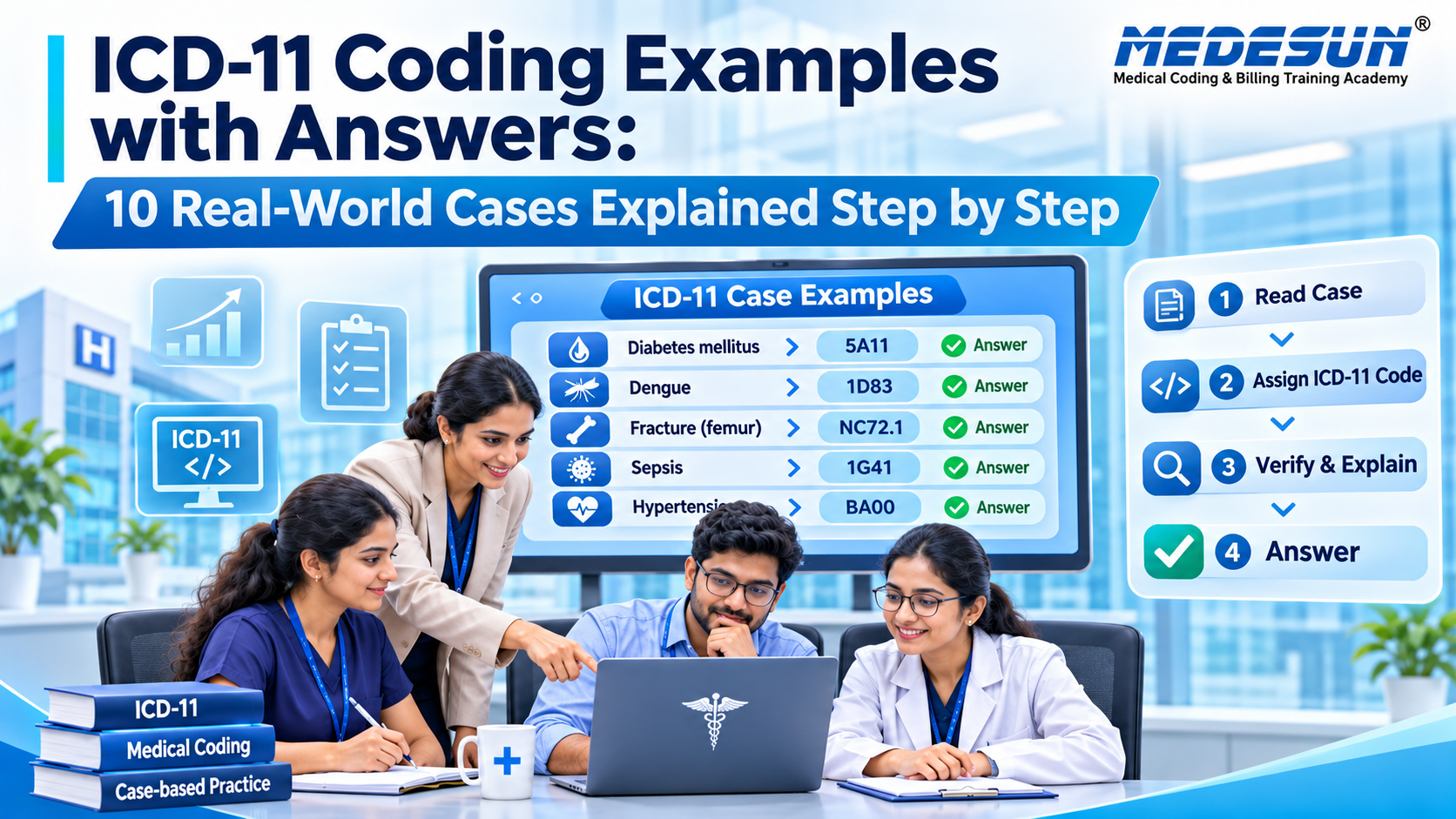
You do not learn to code by reading code books. You learn by coding a record, getting it wrong, and understanding why. That is the method behind every MEDESUN classroom, and it is the method behind this article.
Below are ten ICD-11 examples drawn from conditions Indian hospitals see every day. Try each one yourself before reading the answer. Then verify every code in the WHO ICD-11 Browser, because a good coder never trusts a code they have not checked.
How should you approach an ICD-11 case?
Use the same four steps every time. One: read the full record and identify the main condition. Two: search the WHO Coding Tool using the clinical term, not a code you remember from ICD-10. Three: read the coding notes and postcoordination axes on the stem code. Four: add only the extensions the documentation supports. Codes below are from ICD-11 MMS and should be verified against the current release (2026-01 at the time of writing).
What are the solved ICD-11 examples?
| # | Case | ICD-11 answer | Why |
|---|---|---|---|
| 1 | Type 2 diabetes mellitus, no complications documented | 5A11 | Type 2 diabetes stem code; no complication documented, so no linked code. |
| 2 | Essential (primary) hypertension | BA00 | Hypertension with no documented cause is essential hypertension. |
| 3 | Dengue with warning signs (abdominal pain, falling platelets) | 1D21 | ICD-11 follows WHO dengue classification: 1D20 without warning signs, 1D21 with, 1D22 severe. |
| 4 | Dengue shock syndrome | 1D22 | Dengue shock syndrome is indexed under severe dengue. |
| 5 | P. falciparum malaria with cerebral involvement | 1F40.0 | Cerebral complication has its own subcategory under 1F40. |
| 6 | Pulmonary TB, sputum smear positive | 1B10.0 | Respiratory tuberculosis, confirmed (bacteriological confirmation documented). |
| 7 | Sepsis with septic shock | 1G41 | 1G40 is sepsis without septic shock; shock documented, so 1G41. Add the infectious agent or source if documented. |
| 8 | Proliferative diabetic retinopathy, left eye, type 2 diabetes | 9B71.01&XK8G/5A11 | Retinopathy requires the causing condition (5A11) linked with /; laterality left is XK8G. |
| 9 | Right intertrochanteric fracture of femur | NC72.30&XK9K | Stem code for the fracture plus the right laterality extension. Add external cause and place of occurrence as documented. |
| 10 | STEMI, acute | BA41.0 | Acute ST elevation myocardial infarction subcategory under BA41. |
What mistakes do beginners make most often?
- Using an extension code alone. Extension codes can never stand without a stem code.
- Linking two stem codes with & instead of /. The ampersand joins extensions; the slash joins stem codes.
- Ignoring “code also” or mandatory postcoordination notes in the browser.
- Adding laterality or severity that the clinician never documented.
- Translating from an ICD-10 code instead of coding from the clinical statement.
Where can I practise more ICD-11 cases?
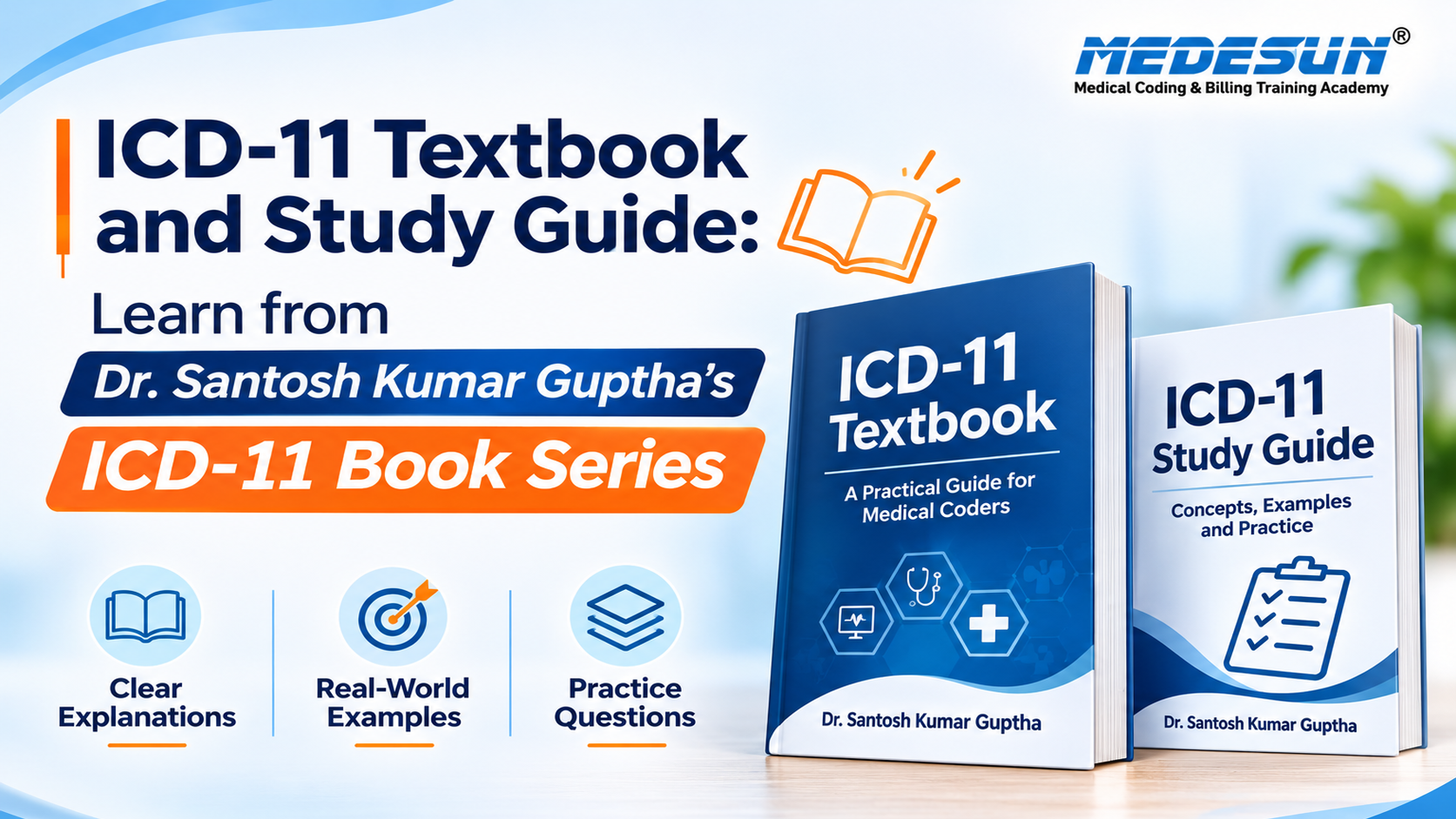
Dr. Santosh Kumar Guptha’s ICD-11 textbooks and his 200-question ICD-11 vs ICD-10-CM comparative workbook contain chapter-wise cases with rationales. MEDESUN students receive graded case sets built from Indian clinical scenarios, with audit-style feedback on every answer.
Who is Dr. Santosh Kumar Guptha?
About the Author
Dr. M. Santosh Kumar Guptha is the Founder and CEO of MEDESUN® Medical Coding Academy and PMBAUSA LLC, and a first-generation AHIMA-Approved ICD-10-CM/PCS and ICD-11 Trainer, trained by CBHI (Central Bureau of Health Intelligence, Government of India) and WHO India.
With 22+ years in medical coding, 43 professional certifications since his CPC® in 2004 (including CCS®, CPC®, CPMA®, CDIP®, CRC®, CIC®, COC® and HIMAA ICD-10-AM Level 1), more than 30,000 professionals trained globally, oversight of coding on about one million records, and nearly seven years working with physicians across Florida, New Jersey, New York, Texas and California, he brings bedside-to-claim experience to every ICD-11 lesson.
ICD-11 books by Dr. Santosh Kumar Guptha:
ICD-11 MMS Comprehensive Textbook (600+ pages)
ICD-10-CM to ICD-11 Transition Textbook: chapter-by-chapter comparative analysis
ICD-11 vs ICD-10-CM Comparative Reference Workbook (200 questions with rationales)
How ICD-11 Will Transform U.S. Healthcare: From Diagnosis Coding and CDI to Reimbursement and Data Analytics (forthcoming)
Frequently Asked Questions (FAQs)
They are taken from WHO ICD-11 MMS. Always verify against the current WHO release before using any code in a live record or claim.
& adds an extension code to a stem code. / links two stem codes that together describe one clinical concept.
You can use the printed tabular list, but the online tool shows postcoordination axes and coding notes that are easy to miss on paper.
Email support@medesunglobal.com to request MEDESUN ICD-11 practice question access.

Train with MEDESUN®
Ready to lead the ICD-11 transition?
ICD-11 is not learned by memorising codes. It is learned by understanding the patient behind the record. That is the heart of MEDESUN's "Intellectual Obesity in Medical Coding" philosophy: clinical reasoning over memorisation.
Whether you are a hospital medical records team, an insurer or TPA, a health-tech company or an individual coder, MEDESUN's ICD-11 programmes, led personally by Dr. Santosh Kumar Guptha, will prepare you to code ICD-11 accurately, defend it in an audit, and lead your organisation's transition.