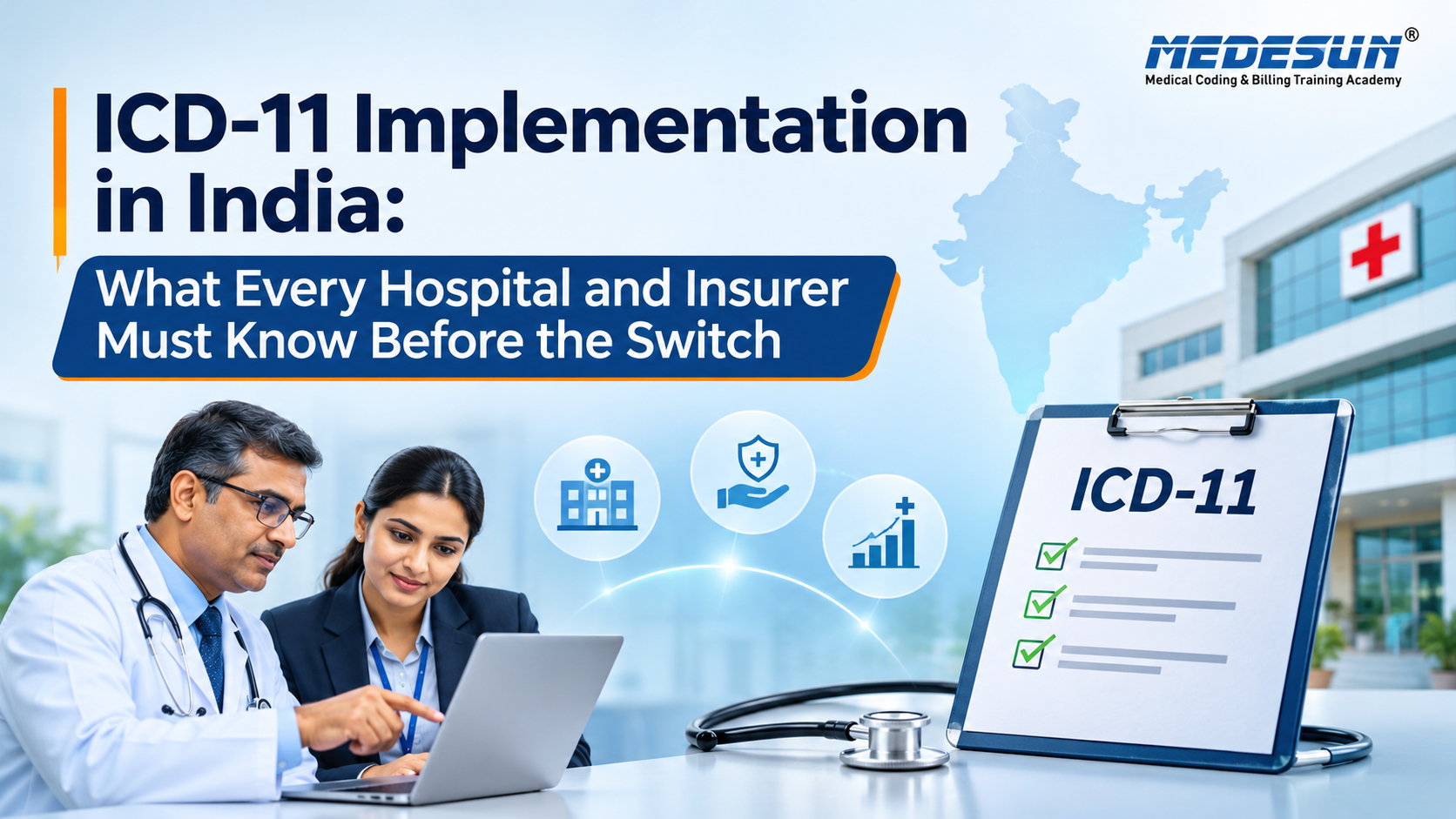
Every discharge summary written in an Indian hospital today becomes a data point tomorrow. It decides how a claim is paid, how a disease is counted, and how a state plans its next budget. For more than two decades, that data point has been an ICD-10 code. That era is ending.
ICD-11, the World Health Organization’s eleventh revision of the International Classification of Diseases, came into effect globally on 1 January 2022. India has formally begun its own transition. The hospitals and insurers who prepare now will avoid the denials, the data gaps and the expensive emergency retraining that hit unprepared organisations during every past code-set change.
Where does India stand on ICD-11 today?
The Central Bureau of Health Intelligence (CBHI), under the Directorate General of Health Services, Ministry of Health and Family Welfare, is India’s nodal agency for the WHO Family of International Classifications. In March 2024, CBHI hosted a two-day national workshop that marked the start of India’s transition from ICD-10 to ICD-11. About 180 experts attended in person and around 300 joined online, including officials from the Registrar General of India, ESIC, Defence, Railways, and major government and private medical institutes.
The workshop worked on five practical areas: governance roles at national, state, district and block levels; pre-transition preparedness, including lessons from the National Health Authority (NHA); a nationwide capacity-building plan for ICD-11 coding guidelines and conventions; mandating morbidity and mortality coding with periodic coding audits; and a monitoring and evaluation framework with performance and quality indicators.
Why is India moving away from ICD-10?
ICD-10 was designed in the 1980s for paper. ICD-11 was built for electronic health records. It has around 17,000 stem categories, a separate set of extension codes for detail such as laterality, severity and histopathology, and a postcoordination system that lets coders combine codes into clusters instead of hunting for one pre-built code that may not exist.
For India specifically, ICD-11 matters for three reasons. It aligns India’s mortality and morbidity reporting with the global standard WHO now maintains. It fits the digital rails of the Ayushman Bharat Digital Mission (ABDM). And it includes the Traditional Medicine Chapter, now extended with the TM2 module for Ayurveda, Siddha and Unani, which no previous ICD revision offered.
What changes for hospitals?
Hospitals feel the change first, because hospitals generate the record. Under ICD-11 the quality of the code depends directly on the quality of the documentation. A clinician who writes “fracture femur” gives the coder almost nothing. A clinician who writes “right intertrochanteric fracture of femur, fall at home” allows a precise cluster such as NC72.30&XK9K plus the cause and place codes.
- Medical records departments need ICD-11-trained coders and a documented coding policy.
- HIS and EMR vendors must support alphanumeric stem codes, extension codes and clusters with the & and / separators.
- Clinical documentation improvement (CDI) becomes a daily discipline, not a one-time training.
- Internal coding audits, as CBHI’s roadmap recommends, must be scheduled and measured.
What changes for health insurers and TPAs?
For insurers, ICD-11 is a claims-intelligence opportunity. Clusters carry severity, laterality and cause in a structured form, which improves medical necessity review, fraud analytics and actuarial pricing. The flip side is that adjudication rules, package mappings and fraud models written around ICD-10 must be rebuilt and tested. An insurer who maps ICD-11 lazily back to ICD-10 throws away exactly the detail that makes the new system valuable.
How should an organisation start its ICD-11 transition?
Start with people, not software. Identify the coders, CDI specialists, claims doctors and auditors who will touch ICD-11 data. Train a core group to trainer level. Run a dual-coding pilot on a sample of real records, ICD-10 and ICD-11 side by side, and measure accuracy and turnaround time. Then fix documentation templates, then software, then go live in phases. This is the same sequence CBHI’s roadmap points to: governance, preparedness, capacity building, audits, and measurement.
Who is Dr. Santosh Kumar Guptha?
About the Author
Dr. M. Santosh Kumar Guptha is the Founder and CEO of MEDESUN® Medical Coding Academy and PMBAUSA LLC, and a first-generation AHIMA-Approved ICD-10-CM/PCS and ICD-11 Trainer, trained by CBHI (Central Bureau of Health Intelligence, Government of India) and WHO India.
With 22+ years in medical coding, 43 professional certifications since his CPC® in 2004 (including CCS®, CPC®, CPMA®, CDIP®, CRC®, CIC®, COC® and HIMAA ICD-10-AM Level 1), more than 30,000 professionals trained globally, oversight of coding on about one million records, and nearly seven years working with physicians across Florida, New Jersey, New York, Texas and California, he brings bedside-to-claim experience to every ICD-11 lesson.
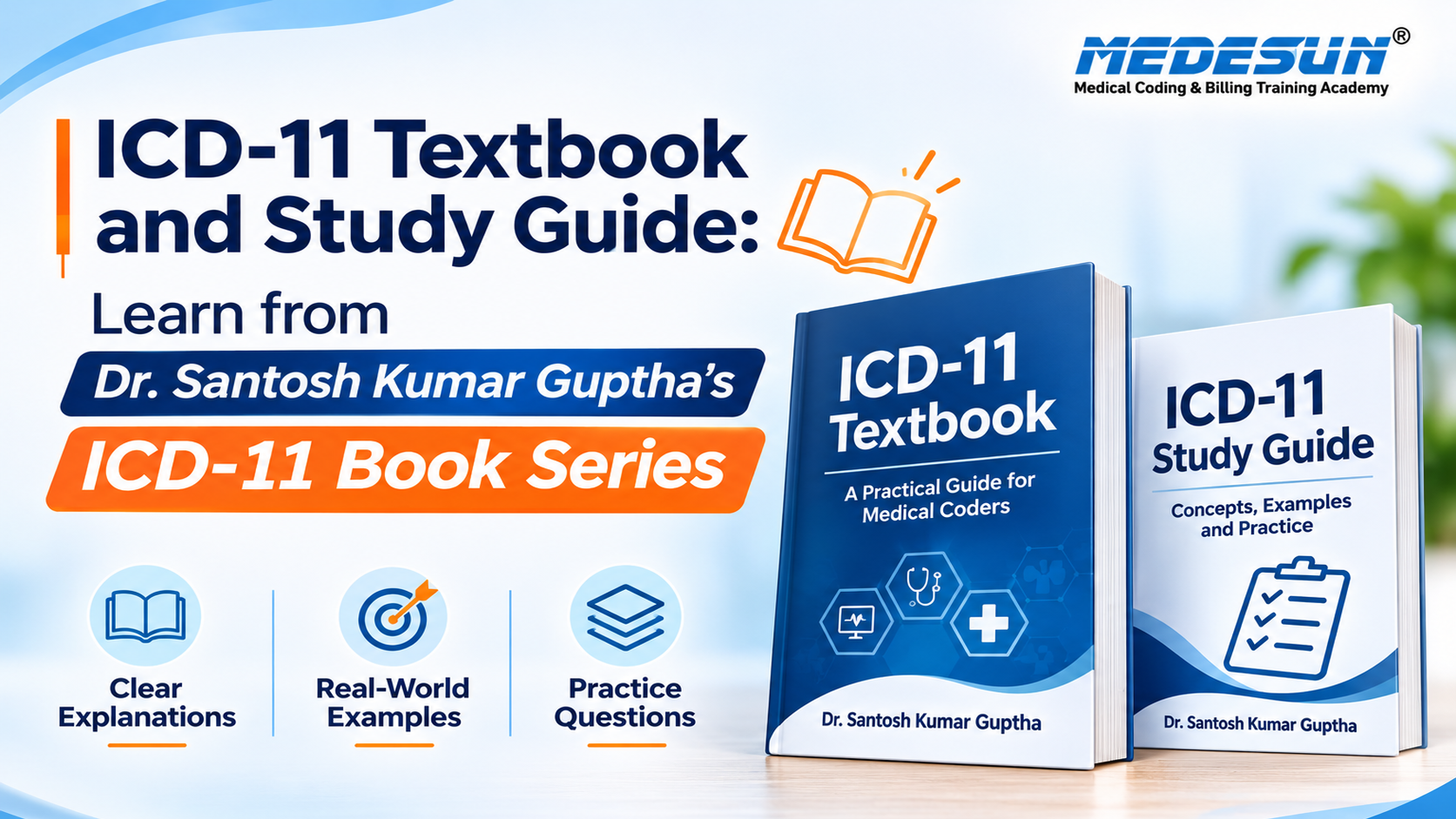
ICD-11 books by Dr. Santosh Kumar Guptha:
ICD-11 MMS Comprehensive Textbook (600+ pages)
ICD-10-CM to ICD-11 Transition Textbook: chapter-by-chapter comparative analysis
ICD-11 vs ICD-10-CM Comparative Reference Workbook (200 questions with rationales)
How ICD-11 Will Transform U.S. Healthcare: From Diagnosis Coding and CDI to Reimbursement and Data Analytics (forthcoming)
Frequently Asked Questions (FAQs)
India has formally launched its transition. CBHI held the national launch workshop in March 2024, and implementation is being phased in across institutions. Hospitals and insurers should track CBHI and Ministry of Health notifications for mandatory dates.
The Central Bureau of Health Intelligence (CBHI), under DGHS, Ministry of Health and Family Welfare, is the nodal agency for WHO classifications in India.
No. Transitions run in phases, often with a period of dual coding. Organisations that train early can move at their own pace instead of under deadline pressure.
MEDESUN Medical Coding Academy offers ICD-11 training led by Dr. Santosh Kumar Guptha, an AHIMA-Approved ICD-10 and ICD-11 Trainer trained by CBHI and WHO India.

Train with MEDESUN®
Ready to lead the ICD-11 transition?
ICD-11 is not learned by memorising codes. It is learned by understanding the patient behind the record. That is the heart of MEDESUN's "Intellectual Obesity in Medical Coding" philosophy: clinical reasoning over memorisation.
Whether you are a hospital medical records team, an insurer or TPA, a health-tech company or an individual coder, MEDESUN's ICD-11 programmes, led personally by Dr. Santosh Kumar Guptha, will prepare you to code ICD-11 accurately, defend it in an audit, and lead your organisation's transition.